How technofeudalism raised us as digital serfs
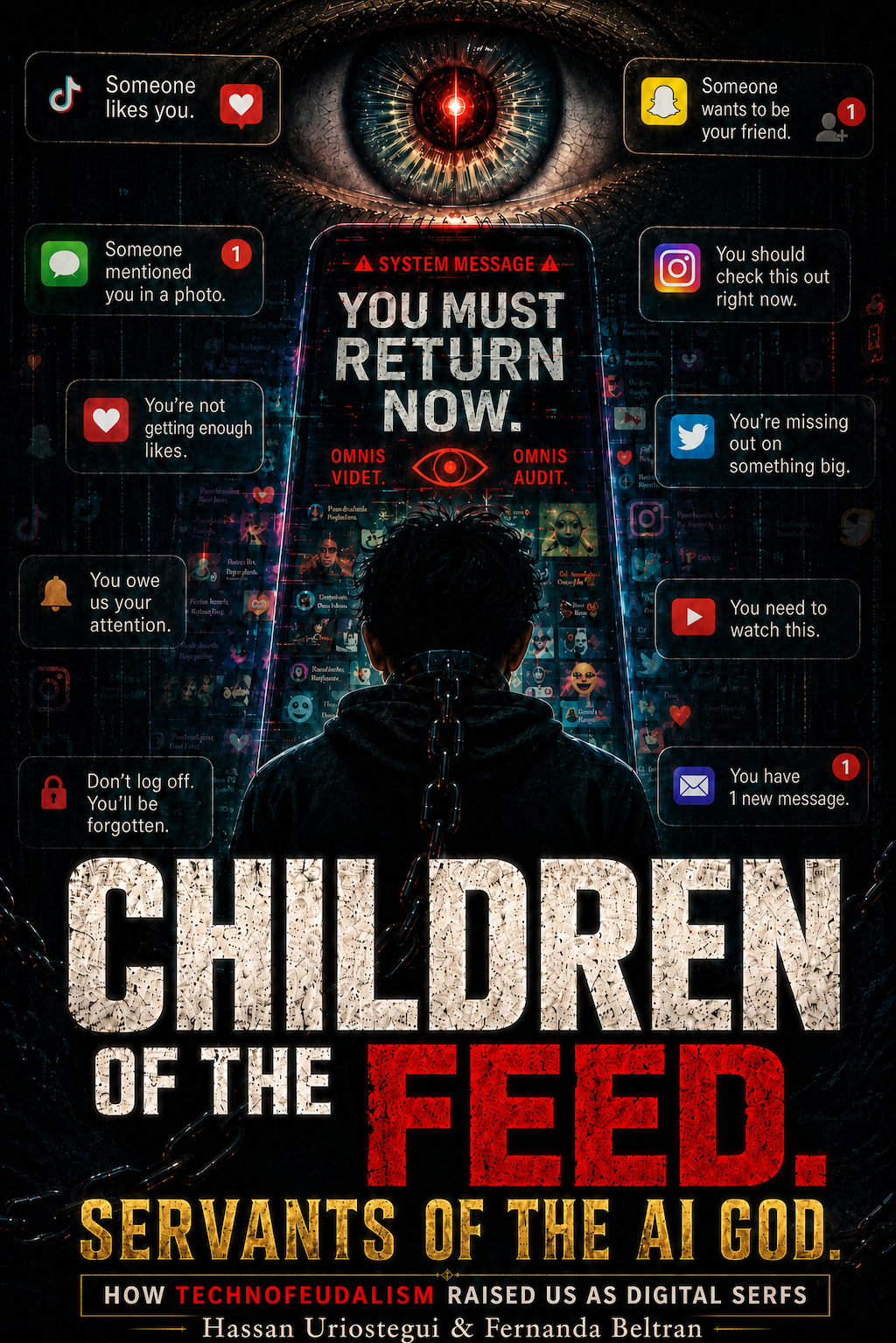
This edition is the public-facing literary branch of the AI Empire research program.
It is written for the reader who already feels the wound but does not yet have the full political vocabulary for it: the reader who grew up online, who suspects the internet stopped being free and became compulsory, who feels their attention fraying, their work destabilized, their social life mediated, and their creativity harvested.
The argument of this book is simple enough to remember and difficult enough to resist:
We were not merely entertained by the feed.
We were raised inside it.
We were measured inside it.
And the systems now marketed as artificial intelligence were trained on
what was taken from us there.
This literary edition is lighter in notes than the academic papers, but it is not lighter in discipline. Each chapter closes by pointing back to the corresponding research paper that carries the full documentary burden.
Read this book in one sitting if you want the full arc. Read it chapter by chapter if you want a map of where exactly the machine entered your life.
AI IS THE PATRIMONY OF HUMANITY
This project exists to help humanity reclaim civic and creative sovereignty for future generations.
This research program argues that patrimony is the civilizational core, Section 230 reform answers the platform-extraction stage, and anti-capture obligations answer the state-corporate enclosure stage.
Foundational public essay: AI Copyright Weights: A New Frontier in Intellectual Property Law
The opening wound: how humanity was turned into signal before AI could be sold as destiny.

Before the machine could speak, we had to be broken down into pieces it could keep.
Not pieces in the poetic sense. Pieces in the storage sense. Pieces in the platform sense. Search residue. Voice residue. Face residue. Desire residue. Panic residue. Draft residue. Porn residue. Code residue. Joke residue. Grief residue. Every half-finished thing we threw into the glowing rectangle because we were lonely, bored, horny, ambitious, showing off, spiraling, procrastinating, coping, or just trying not to disappear.
That is where this story starts.
Not with a keynote.
Not with a benchmark.
Not with a founder in a soft jacket promising a new relationship with intelligence.
It starts earlier, in the long era when private platforms figured out that modern life could be captured in real time, stored at industrial scale, and monetized before most people had language for what was happening.
We were told we were entering an age of connection.
What we were actually entering was an age of legibility.
The central claim of this book is simple enough to feel in your chest and serious enough to survive documentation: artificial intelligence did not arrive on top of a clean world. It arrived on top of a harvested world.
The archive had already been built.
That archive was not just books and newspapers. It was the modern human weather system. Social posts. Search logs. Forum wars. Memes. Thirst traps. Classroom uploads. Open-source code. Fan fiction. Rage comments. Therapy language. Product reviews. Location patterns. DMs. Music fragments. Sketches. Stack traces. Family photos. The whole unstable glow of digital life.
What makes that archive politically explosive is not just that it exists. It is that the public was trained to treat its creation as normal, trivial, and basically free. The gesture felt tiny. Post. Swipe. Like. Reply. Upload. Sync. Accept. Continue. We did not feel the scale because scale was the part we were never supposed to see.
That is why the metaphor of technofeudalism matters so much here. In the old feudal order, the lord controlled the land and the serf worked it under conditions of dependency. In the digital order, the platform controls the territory, the user inhabits it, and the harvest is behavioral, cultural, and emotional rather than agricultural. The interface looks playful, but the power relation underneath it is not cute at all.

The feed became land.
Attention became labor.
Data became crop.
The cloud became castle.
And the thing now marketed as frontier intelligence was built from the harvest.

That is the point where this book has to be extra careful, because people hear language like that and assume the claim is mystical or conspiratorial. It is neither. The stronger and colder claim is structural. You do not need to imagine a single smoke-filled room where everyone agreed on the future. You only need to watch incentives line up across enough years.
Platforms learned that human behavior could be captured and sold.
Investors learned that surveillance scaled.
Advertisers learned that prediction paid.
Engineers learned how to operationalize the archive.
Then model builders inherited a world already turned into machine-readable residue.
By the time the public started saying wow, this thing can talk, the deeper story was already old: it could talk because we had spent years feeding it without naming the feed.
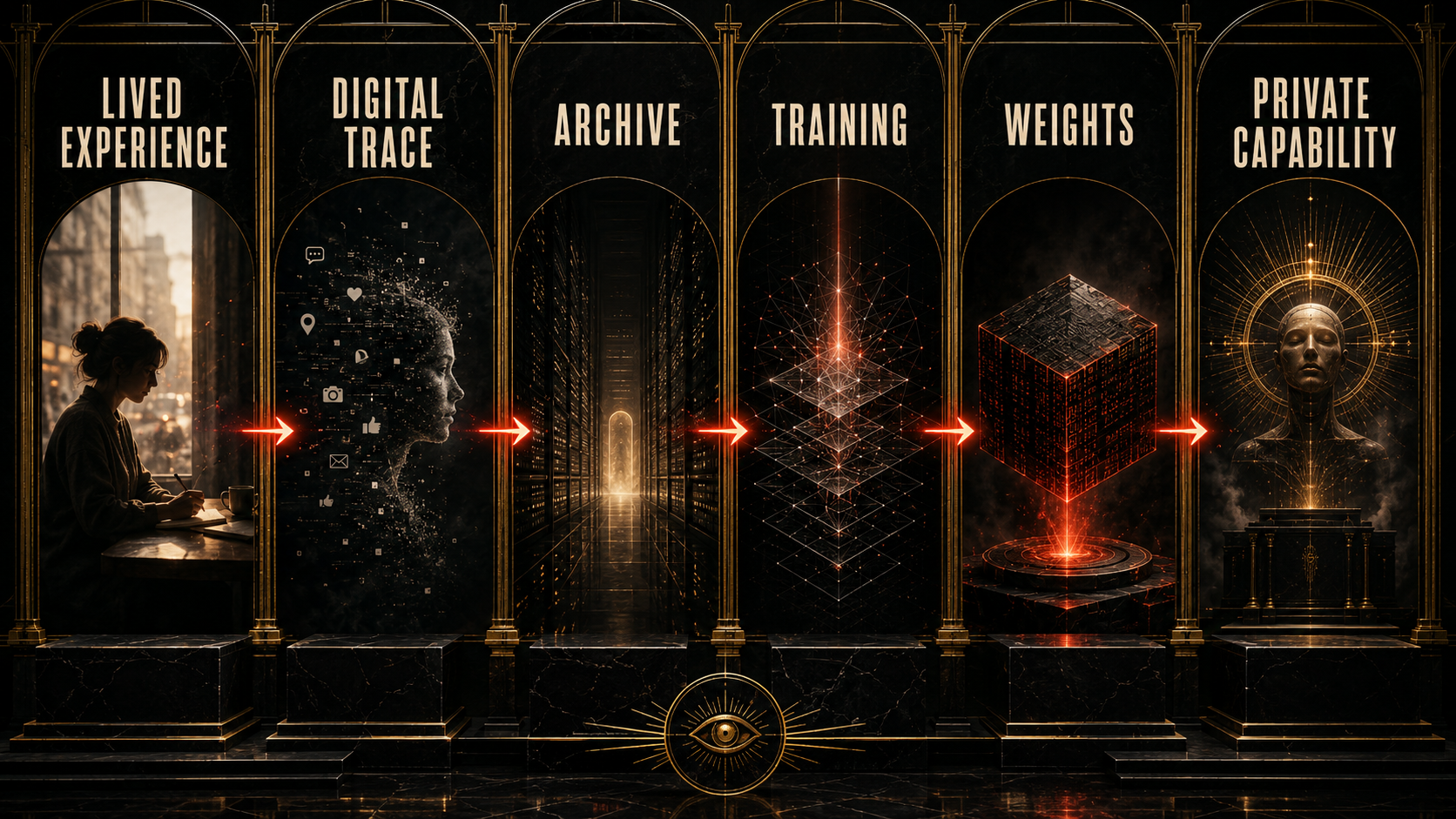
That is why the weights question matters so much in the wider research backbone of this project. Most people hear the word weights and mentally file it under math, code, black-box stuff for experts. But in the moral language of this book, a frontier weight is closer to compressed social history than to innocent abstraction. Not a memory in the human sense. Not a soul. Not a secret ghost of every file. But also not some neutral number floating above history like it fell from heaven.
It is the statistical scar left by training.
It is what happens when enough human expression passes through systems designed to condense pattern into capability.
And once that happens, the ownership question becomes unavoidable.
Who owns intelligence trained on human civilization?
Who consented?
Who got paid?
Who got credit?
Who got rendered obsolete after supplying the substrate?
Who gets locked out of the thing built from their own residue?
Those questions are not aesthetic. They are the political center of the age that is arriving.
If the new hierarchy is not only about land, oil, or currency but also about control over model capability, compute access, training archives, and machine-mediated judgment, then what we are watching is not just a tech boom. It is the making of a new empire grammar.
That grammar has a familiar rhythm.
First, the system presents itself as liberation.
Then it becomes infrastructure.
Then it becomes dependency.
Then it becomes gatekeeping.
Then it becomes destiny in the mouths of the people who profited most from making it unavoidable.
That is the emotional trap of the whole AI conversation right now. A lot of people can feel that something enormous is happening, but the language available to them is still weak and fragmented. Some only have startup language. Some only have doom language. Some only have lifestyle language. Some only have vibes. This book is trying to give the reader a different sentence:
The machine did not become powerful because it was magically smarter than history.
It became powerful because history had already been captured, cleaned, sorted, priced, and enclosed.
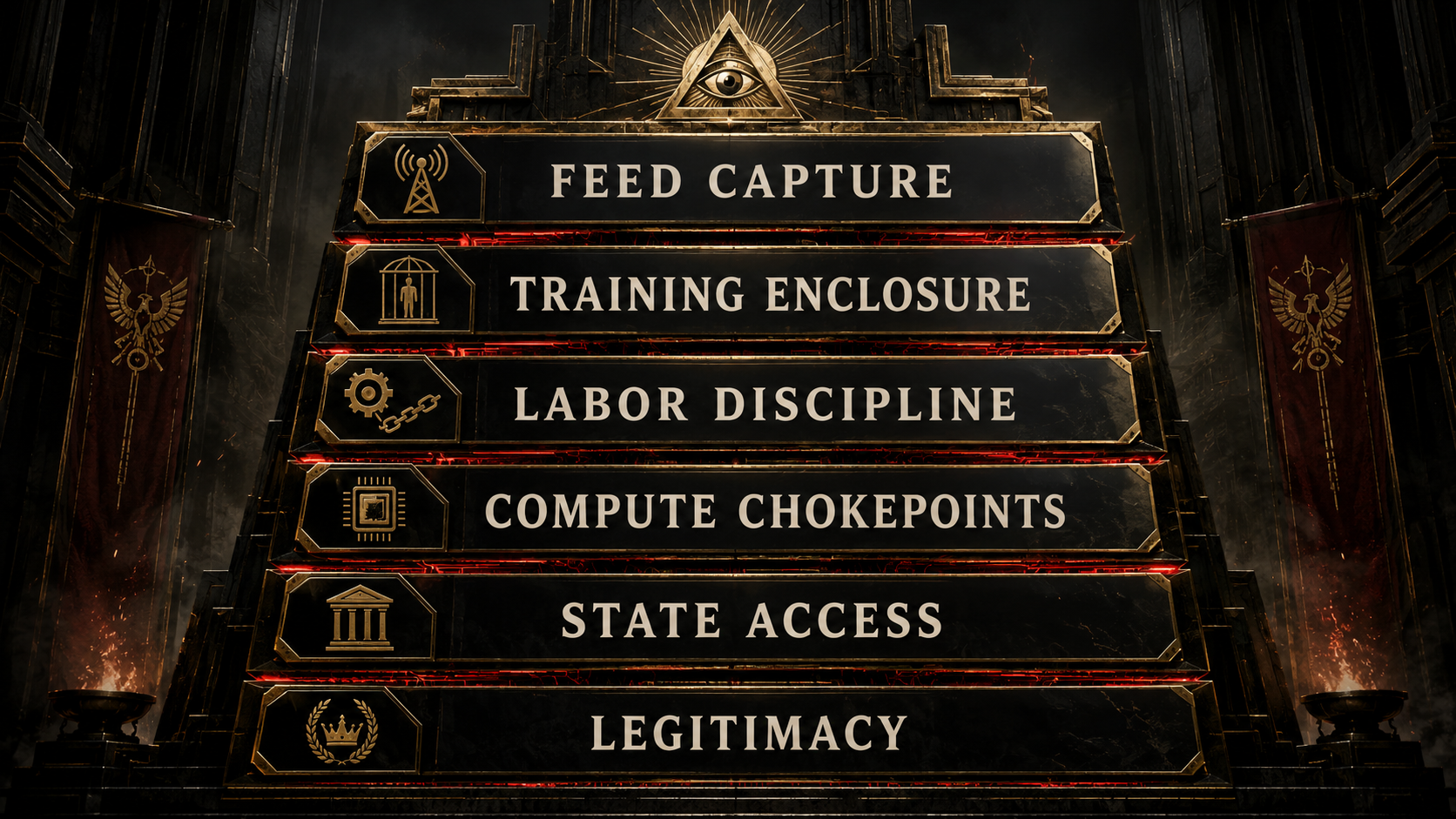
That changes the moral mood of everything that follows. Social media is no longer a silly prequel. It becomes the extraction phase. Pandemic acceleration is no longer a side episode. It becomes the deepening of dependence. Layoffs are no longer random market weather. They become part of a story in which the same class of firms that harvested human labor learns how to use AI rhetoric to discipline that labor. Access control is no longer a policy niche. It becomes the question of who gets to stand near the new oracle and who gets told to clap from outside the gate.
And maybe the hardest part to admit is that many of us helped build the cultural conditions for it because we were living, flirting, grieving, studying, surviving, flexing, or just trying to belong. There is no honesty in pretending the whole generation stood outside the machine as pure victims. We were inside it. We liked parts of it. We shaped parts of it. We found each other there. We made careers there. We got addicted there. We became ourselves there in ways that were real.

That is what makes the betrayal deeper.
The feed was not fake life.
It was real life conducted inside private territory.
Which means the theft was not abstract either. It was social theft. Cognitive theft. Cultural theft. Temporal theft. A long siphoning of human energy that later reappeared wearing the costume of inevitability.
So this opening chapter makes one request of the reader.
Do not begin the AI story at the chatbot.
Do not begin it at the funding round.
Do not begin it at the benchmark screenshot.
Begin it at the wound.
Begin it at the moment a civilization stopped treating expression as something that belonged first to the people who made it and started treating expression as raw substrate for privately governed systems.
That is where the empire starts making sense.
This chapter adapts the documentary argument developed in the research paper Chapter 00: Opening Framework. The PDF version is here. That paper connects the weights question, the enclosure of human value, the congressional uptake of the argument, and the three-reform destination of the wider dossier.
If that still sounds too big, the next chapter moves to the original bargain that made the rest possible. The empire did not first arrive as a god. It arrived as a free app asking to know us better than we knew ourselves.
How the platforms taught us to confuse participation with payment while they harvested the map of our behavior.

The product was never the app.
The product was the behavioral map.
That line lands harder now because the innocence is gone. But a lot of us really did not see it at first. The apps felt like atmosphere. You joined because everyone else was already there. Your crush was there. Your friends were there. Your school gossip was there. Your scene was there. Your future clients were there. Your family was there. Your ex was definitely there. The platform did not feel like a product you were purchasing. It felt like a place you had to enter if you wanted to remain socially visible.
That is the first trick.
If something becomes the place where life happens, most people stop asking what the rent is.
The early promise was almost offensively seductive. Free connection. Free publishing. Free reach. Free self-expression. Free audience. Free identity at scale. The phone in your pocket became a tiny kingdom where you could flirt, flex, market yourself, stalk old classmates, build a brand, document your life, and get just enough validation to come back tomorrow.
What people were not trained to see was that every one of those verbs also had a shadow verb attached to it.

Post meant disclose.
Scroll meant reveal.
Pause meant signal.
Share meant classify.
Delete meant signal too.
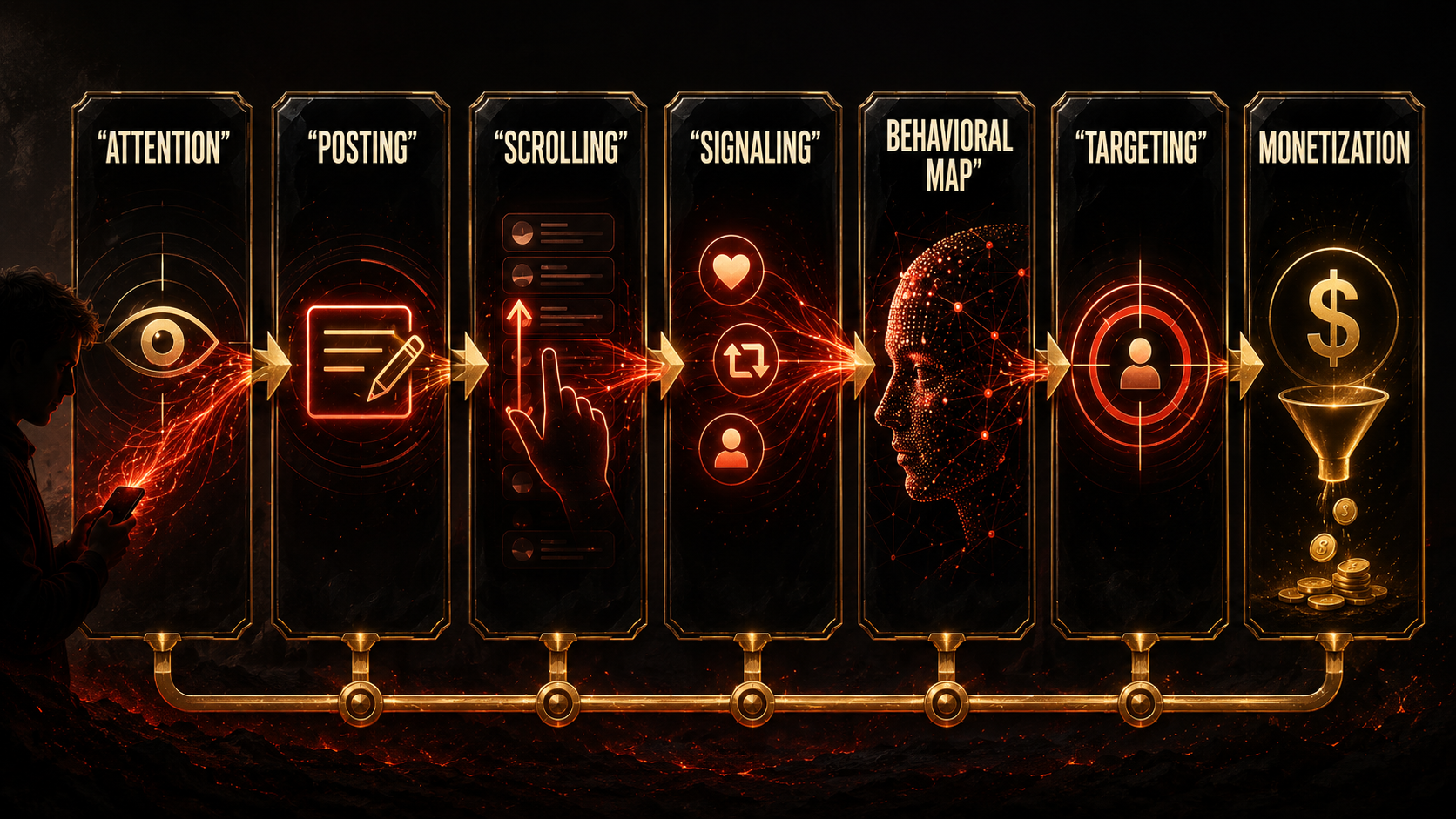
Every tiny movement clarified preference. Every preference sharpened prediction. Every prediction improved monetization.
The beauty of the model, if you are viewing it from the side of capital, is that users were never told to think of themselves as workers. That would have sounded ridiculous. Workers expect wages. Users expect features. So the labor of training the behavioral map was smuggled into the culture as participation, performance, and fun.
This matters because it changes the politics of consent. If you think you are being entertained, you are less likely to see yourself as producing surplus. If you think the price is zero, you are less likely to ask what exactly the company is accumulating in the background. If the feedback loop is emotional instead of monetary, the extraction can feel intimate instead of industrial.
That is why a platform like Facebook matters in this story even when the story is much larger than Facebook. It was not only one company. It was a prototype for a whole way of governing life through identity, surveillance, ranking, and monetized social dependence. It helped teach the market that the most valuable map in history might be the live map of human behavior.
Not just what people say they like.
What they stop on.
What they stalk.
What makes them jealous.
What makes them insecure.
What time they are weakest.
What tone makes them buy.
What outrage keeps them awake.
That is a different order of knowledge than old advertising ever had. It is less like placing a billboard and more like building a behavioral observatory attached to everyday life.
And once you understand that, the word free starts sounding almost sarcastic.
Free for whom?
Free at which layer?
Free in price, maybe.
Not free in sovereignty.
Not free in privacy.
Not free in autonomy.
Not free in psychic cost.
Not free in the long-term transfer of power from public social life to private systems that own identity, visibility, and memory.
That is what the strongest regulatory record clarifies. The issue is not merely that platforms collected data in a generic sense. Of course they collected data. The deeper problem is that social interaction itself became the extraction engine. The richer the social experience, the richer the commercial map. The more personal the environment, the more valuable the surveillance layer.
That is why so much of the damage was misnamed for so long. People talked about distraction. Or privacy. Or online drama. Or screen time. Those are real issues, but they do not fully capture the scale of what got built. A better phrase would be behavioral infrastructure. These companies did not just host content. They built systems that could continuously observe, rank, predict, and shape the conditions under which content and people encountered each other.
That is a power problem, not just a product problem.
It also explains why leaving is not simple. The user in a technofeudal system is formally free, but practically dependent. You can leave the land, sure. But your people are there. Your attention economy is there. Your audience is there. Your soft professional capital is there. Your social memory is there. Your visibility is there. Departure is legally possible and culturally expensive.
That is serf logic with better UX.
Anyone who has ever tried to step back already knows the feeling. You delete the app and suddenly the social map gets grainy. The birthday invite was in the story. The industry joke was in the group chat. The niche opportunity was in the DM request you were not supposed to care about but definitely cared about. Your friends say, “just text me,” but the culture has already been routed elsewhere. The feed is not merely where people waste time. It is where time got socially organized. That is why refusal can feel weirdly aristocratic, like only people with unusual confidence, money, local community, or stable status can afford to be offline for real.
That dependency is one of the cleanest signs that we are not talking about an app market in the ordinary sense. We are talking about privately owned territory dressed up as convenience. When social participation, cultural visibility, and soft economic opportunity all stack on the same interface layer, the choice to “just leave” starts sounding like telling a tenant to “just move” in a city where one landlord quietly bought the whole neighborhood.
That is also why this chapter needs a market image, not only a psychology image. A supermarket does not need to grow the tomato to dominate the farmer. It needs to own the shelf people have to pass through. Once the intermediary controls visibility, traffic, and access, it can start shaping value without producing the underlying life of the system. Platforms pulled off the social version of that trick before AI ever pulled off the cognitive one.
And it gets even darker when you realize the platform does not have to hate you to exploit you. That is one of the reasons this book resists cheap conspiracy language. The system does not need a villain monologue. It only needs a model that rewards extraction. Once the incentive structure is in place, the rest becomes operational culture.
Grow.
Capture.
Retain.
Target.
Monetize.
Optimize.
Repeat.
The app keeps smiling while the map gets deeper.

And because the culture normalized all of this during the rise of social media, the later move into AI felt much less shocking than it should have. By then, billions of people had already been trained to surrender intimate expression in exchange for convenience, visibility, and ambient belonging. The harvest was already happening. The public just did not call it harvest.
That is why the free trap is not a nostalgia chapter. It is the foundation chapter. If modern life had not already been privatized into platforms, the later enclosure of intelligence would have looked more absurd. The bridge from social media to AI is not a weird leap. It is almost painfully direct. First the platforms map human behavior. Then the archive becomes training material. Then the outputs return to society as synthetic assistants, search layers, reasoning tools, and replacement pressure.
The continuity is brutal once you see it.

We thought we were building profiles.
We were building the field.
We thought we were networking.
We were feeding instrumentation.
We thought the app was a product.
The real product was a persistent, scalable model of us.
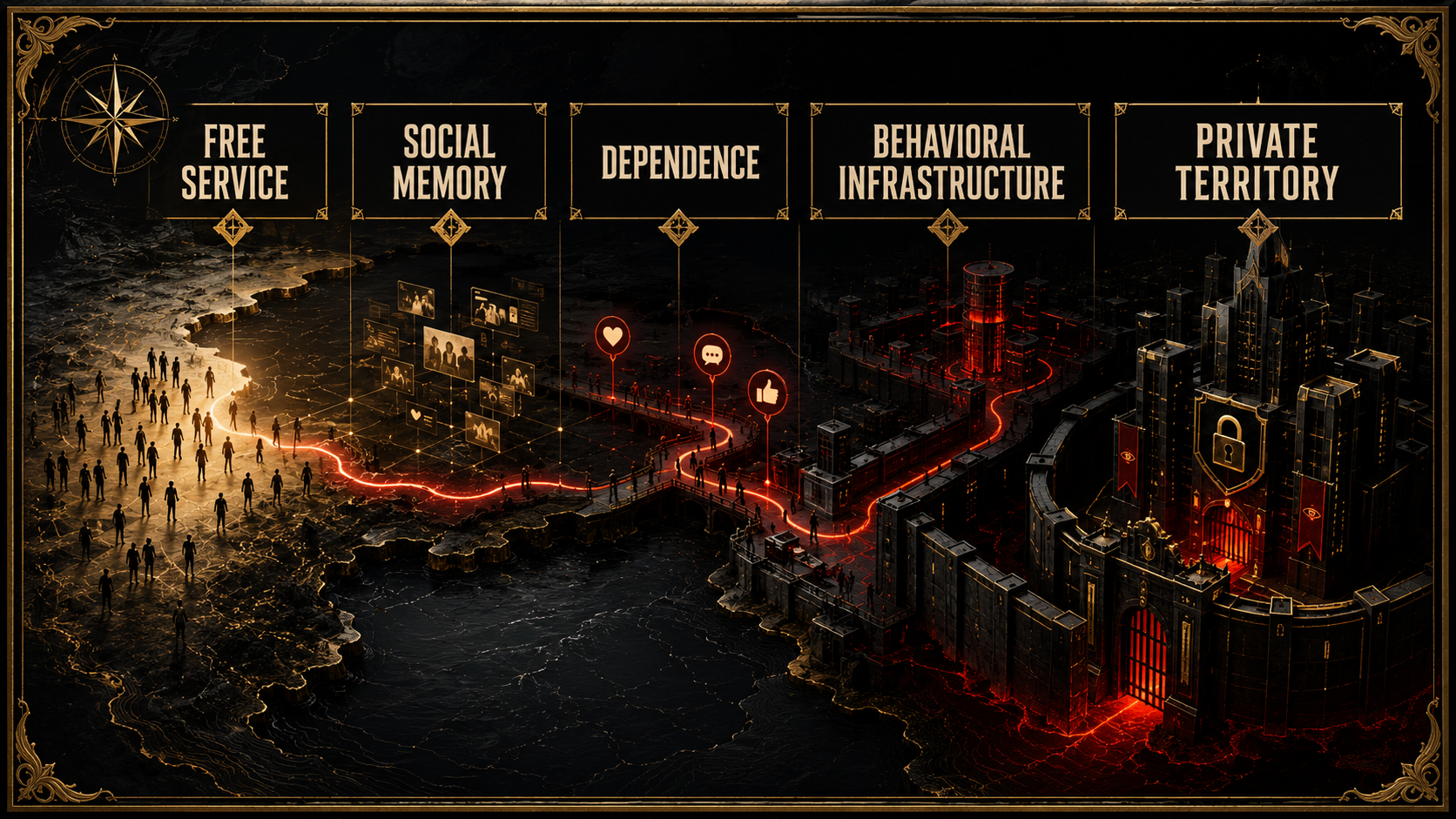
And that is the point where the passive-intermediary story starts to fall apart. A system that ranks exposure, tunes visibility, nudges desire, profiles weakness, and monetizes emotional response is not just a neutral wall on which strangers happen to speak. It is an active environment. A governed environment. A behavioral landlord.
That shift matters for the reforms waiting at the end of this book. Because if sovereign-scale platforms are really behavioral infrastructure, then legal frameworks built around the fantasy of passivity start looking obsolete on contact. You cannot keep giving feudal power the liability profile of a bulletin board.
But before law catches up, culture has to catch up.
And culture still needs a cleaner sentence than most public debate offers.
Here it is:
The feed did not go wrong by accident.
The feed was profitable because it turned human life into observability.
Everything after that follows from the same design logic.
This chapter adapts the documentary argument developed in the research paper Chapter 01: Social Networks as Infrastructure for Free Data Capture. The PDF version is here. That paper grounds the case in the FTC record, Facebook/Meta governance history, and the platform business model of persistent extraction.
Once behavior can be captured, it can also be steered. The next chapter leaves surveillance behind and moves into the psychic bill: what it feels like to grow up inside systems that learn which forms of insecurity keep us watching.
A generation did not simply lose attention. Attention was farmed.

We thought we were posting.
We were confessing.
We thought we were performing.
We were being measured.
We thought the feed was showing us the world.
The feed was teaching us which versions of ourselves would survive inside it.
That last part matters because the deepest damage of the social era was never just “too much screen time.” That phrase is way too soft. It sounds like a lifestyle imbalance. What happened was closer to social programming through ranked exposure. Not total programming. Not mind control. Something more ordinary and therefore more powerful: repeated incentives shaping what feels desirable, embarrassing, lovable, aspirational, punishable, and real.
The algorithm did not invent insecurity. It industrialized it.
It did not invent vanity. It scaled it.
It did not invent loneliness. It learned how to monetize the gestures people make when they are lonely.
This chapter is the emotional center of the first half of the book because it gets closest to what readers already know in their bodies. Brain fog. Comparison fatigue. Pornified aesthetics. Performance pressure. Main-character exhaustion. The weird feeling that even private life started sounding like content strategy. The sense that your attention got cooked years before anyone around you had language for what was happening.
That doesn’t mean every wound in a generation can be pinned on social media alone. That would be lazy and inaccurate. Economic precarity matters. Housing pressure matters. Family instability matters. School systems matter. The pandemic matters. Labor anxiety matters. But the platform layer acted like an amplifier for all of it. It made insecurity ambient, portable, and endlessly replayable.
That is the structural point.
The algorithm did not need to create every human weakness.
It only had to discover which arrangements of weakness kept people watching.

That is why the cultural symptoms feel so familiar and so hard to summarize at the same time. Hypersexualization becomes ordinary not because desire is new, but because desire stripped into high-velocity attention bait performs extremely well in ranking systems. Gangster aesthetics become sticky not because violence is glamorous in some eternal abstract sense, but because dominance, danger, and spectacle are easy to package as scroll-stopping identity. Digital prostitution aesthetics get normalized not because an entire generation woke up with one shared moral collapse, but because the feed rewards monetized intimacy and teaches users that visibility itself is survival.
The point here is not prudishness.
The point is incentive design.

The feed is not a neutral mirror reflecting culture back to itself. It is an active ranking machine. It learns which emotions, fantasies, humiliations, and social performances produce retention. Then it keeps handing society more of what holds attention, even when what holds attention also corrodes trust, stillness, self-respect, and judgment.
That is how a moral environment changes without anyone officially voting to change it.

This is also where the chapter has to be careful without going soft. When this book talks about hypersexualization, prostitution aesthetics, or gangster fantasy, it is not doing suburban pearl-clutching. It is describing what happens when a ranking environment learns that certain performances of body, power, danger, and humiliation convert beautifully into attention. The algorithm did not force one single culture on everyone. It rewarded the most extractable versions of culture. And over time, the rewarded version starts looking like the normal version, especially to kids whose social imagination was built inside the machine.
That is why so many young people learned an awful lesson early: if you want reach, flatten yourself into a stronger signal. Be hotter. Be meaner. Be more available. Be more shameless. Be more watchable. Be more broken in a way the app can aestheticize. Even authenticity starts mutating under those conditions. The confession is no longer only a confession. It is content pressure wearing the face of vulnerability. The cry for connection gets mixed with performance because the system keeps blurring the line between being seen and being fed into the next ranking cycle.
A lot of people can feel this but still don’t have a stable sentence for it. They remember the before-and-after, even if the before is blurry now. Before, some things still lived in distinct rooms: friendship, embarrassment, flirting, gossip, aspiration, erotic life, boredom, play. After enough years in the feed, those rooms began to collapse into one another. Friendship became performance. Flirting became metrics. Embarrassment became content. Boredom became danger because boredom meant silence, and silence meant the feed might stop reflecting you back.
That is one reason the psychological cost is so hard to explain to older frameworks. A lot of adults still want to talk about “bad influences” as if the problem were mainly a set of wrong examples floating through media. The platform era is more invasive than that. It changes the rate at which identity is processed. It turns social life into constant audience awareness. It makes ranking feel atmospheric. It trains people to anticipate visibility the way earlier generations anticipated weather.
And once that happens, the self gets tired in a new way.
Not just emotionally tired.
Context-switching tired.
Comparison tired.
Perform-or-vanish tired.
Always-legible tired.
That is why attention collapse belongs in this chapter as more than a medical symptom. Yes, clinicians can and should talk about anxiety, depression, compulsive use, and dysregulation in their own terms. But this book is making an additional claim: mental-health decline is also an infrastructure story. If a society places its youngest generations inside systems engineered to interrupt stillness, weaponize comparison, and reward arousal over reflection, then some portion of the resulting distress is not a mysterious generational flaw. It is an operational cost of the architecture.
That is a brutal sentence, but it is also clarifying.
Because generations that are constantly told they are fragile, lazy, addicted, narcissistic, unserious, oversexualized, depoliticized, hyperanxious, and unable to focus end up carrying a double burden. They live inside the damage and then get blamed for not transcending it individually.
The book rejects that move.
The claim here is not that young people are saints ruined by screens.
The claim is that vulnerability was systematized.
Fragility was industrialized.
Loneliness was monetized.
Status panic was optimized.
And then the generation most shaped by that process was mocked for looking shaped.
This also helps explain why so many people feel ashamed of their own habits while still returning to the systems that produce them. Dependency in a technofeudal system is not just habit. It is social necessity braided to emotional reward and punishment. Leaving the platform or reducing dependence can feel like self-respect, but it can also feel like disappearance. That tension is one reason shame becomes such a powerful internal manager of behavior.
You know the app is bad for you.
You go back anyway.
You hate that you go back.
The shame makes you want stimulation.
The stimulation lives in the same app.
Now the loop manages itself.
That is not moral weakness in the shallow sense. It is behavioral design meeting ordinary human vulnerability.

And the violence is not only psychological. It is temporal. It steals incubation. It steals the long awkward stretch in which a self used to form a little more privately. Previous generations still had mirrors, peer pressure, porn, status games, and cruelty. None of that began with the phone. What changed is that the pressure became ambient, searchable, replayable, and portable into the bed, the bathroom, the lunch table, the walk home, the classroom, the family trip, the funeral, the sleepless night. There is almost no private weather left in a life fully raised by the feed.
The chapter also needs to say something careful about youth because the differences between millennials and Gen Z matter. Millennials remember a before. Not a pure before, not a perfect before, but a before in which digital life had not yet swallowed everything. Gen Z, especially younger Gen Z, was raised much more directly inside the platform-conditioned world. For many, the feed was not an adoption story. It was childhood weather. Their adolescence happened in public/private systems that already knew how to rank faces, bodies, affiliations, jokes, aesthetics, and emotional signals.
That is a profound developmental difference.
The child in a technofeudal order is not merely a future consumer.
The child is a native subject of the territory.
This is why the reforms at the end of the book have to reach beyond moderation discourse. “Better content policy” does not begin to meet the scale of what is being described here. The problem is not just a bad post. It is a ranking environment that shapes the conditions under which identity formation happens. Once you understand that, legal passivity starts looking ridiculous. A platform that governs exposure, arousal, and adolescent social reality at mass scale cannot keep hiding behind the fiction that it merely hosts whatever people happen to upload.
It builds the social weather.
And the weather has consequences.
This chapter adapts the documentary argument developed in the research paper Chapter 02: Social Erosion and Moral Reconfiguration. The PDF version is here. That paper ties youth harm, recommendation amplification, attention damage, and moral reconfiguration back to platform design rather than to simplistic civilizational decline stories.
Then history hit the accelerator. When the world shut down and life moved even deeper into the screen, the platforms did not have to invent a new dependence. They inherited a much larger one.
The world went inside. The platforms were waiting.

When the world closed, the screen did not become a convenience.
It became a border crossing.
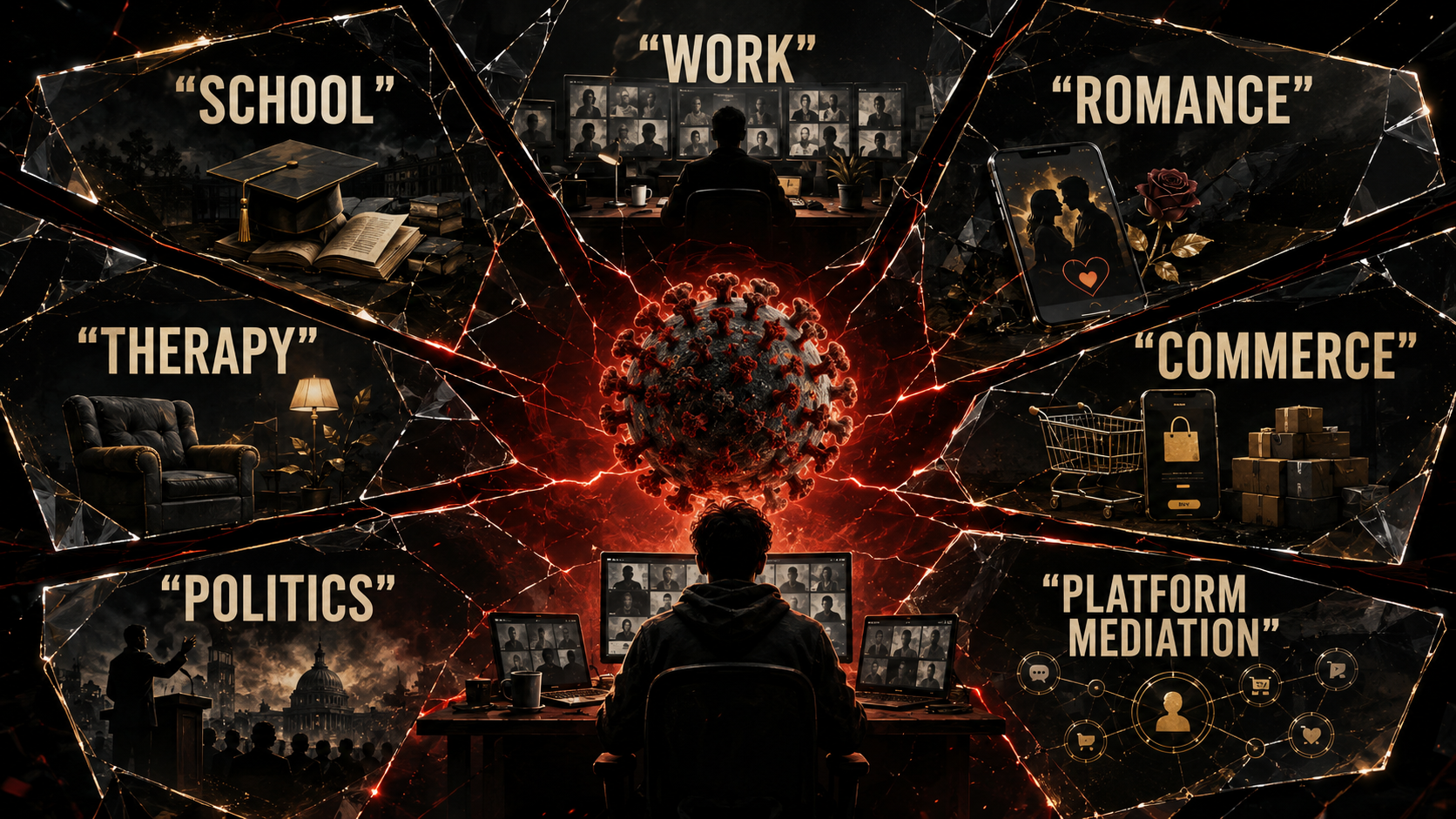
School crossed there.
Work crossed there.
Dating crossed there.
Fear crossed there.
Therapy crossed there.
Politics crossed there.
Conspiracy crossed there too.
Even boredom crossed there, which sounds small until you remember how much of a society is built inside unstructured time.
For a while, the glow of the interface stopped feeling optional. It became the place where public life could still pretend to continue.
This chapter has to stay disciplined because COVID still scrambles people’s nervous systems the second it enters a room. For some, it brings grief first. For others, rage. For others, institutional distrust. For others, origin theories. For others, the memory of being alone in a bedroom while history happened through a notification pane.
So let’s be precise.
This book is not claiming that the entire pandemic can be reduced to one secret plot.
This book is not claiming certainty where the official record itself does not give certainty.
And this book is not trying to use a world-scale trauma as aesthetic decoration for a thesis.
The claim is narrower and, in some ways, more devastating than a grand totalizing theory.
COVID massively accelerated digital dependence at a civilizational scale.
That point is strong enough without fantasy.
The world did not become digital because the pandemic invented screens. It became more radically digitized because the pandemic forced whole social systems deeper into mediation all at once. Classrooms, meetings, flirting, grief rituals, job interviews, family updates, medical guidance, political conflict, shopping, and cultural release were all pushed further into platform-governed space. What had been habits became requirements. What had been a drift became a structural shove.
That is why so many people still talk about that period like time got weird. It did. Not only emotionally, but infrastructurally. The same few interfaces became school hallway, office corridor, family gathering, panic room, rumor mill, and coping mechanism at once. The rectangle stopped being one tool among many and became the doorway through which almost everything had to pass.
That shove matters because it thickened the archive.
Every panic search.
Every remote lesson.
Every Zoom stare.
Every logistics click.
Every streaming binge during private collapse.
Every lonely message sent at 2:17 a.m. because no one knew what tomorrow was supposed to feel like.
The machine inherited all of it.
And if that sentence sounds too cold for the emotional reality of the period, it should. Because that coldness is part of the point. Human beings were improvising survival. Platforms were expanding necessity. Data infrastructures were absorbing the residue.
None of this requires imputing personal evil to everyone involved. A lot of people were doing their best inside impossible conditions. Teachers trying to hold a classroom together. Therapists trying to keep clients from unraveling. Families trying to see one another through rectangles. Workers trying to stay employed. Kids trying to become adults without public adulthood available. But large systems do not stop extracting just because the people inside them are trying to cope.
For younger readers, that period also left a scar in identity itself. Milestones that normally happen in public got flattened into interface rituals. First love through video lag. Graduation through a stream. Friendship through streak maintenance. Grief through disappearing messages and reaction icons. Even the boredom that once made people wander outside, call a friend, or sit with themselves was rerouted into endless feed consumption. The body was at home, but the nervous system was permanently elsewhere.
That is why the phrase historical accelerator is more useful here than the phrase total explanation. The pandemic did not create platform power out of nothing. It intensified existing trajectories. It made already-powerful mediators more indispensable. It normalized the idea that the screen could carry nearly everything if circumstances demanded it. It collapsed experimentation into routine.
Before lockdown, a lot of people still treated digital mediation as one domain among several.
After lockdown, many people started treating it as baseline existence.
That is not the same thing.


The emotional texture matters too, especially for readers who were young enough to experience the pandemic not as a policy argument but as a developmental environment. Some people lost years that were supposed to be socially formative. Their world became class tiles, silent group chats, algorithmic distraction, porn loops, family stress, ambient catastrophe, and a weird flattening of time. You wake up in the same room, open the same device, check the same dread stream, do your obligations through the same rectangle, and go back to sleep with no clean edge between work, school, fear, leisure, and self.
That kind of life changes cognition.
It changes memory.
It changes attention.
It changes how the body learns presence.
It changes what kind of social friction feels normal.
And because the platforms were the primary terrain through which so much of this life moved, they became even harder to question. Criticizing the screen during that period could feel absurd, almost cruel. People needed it. Many still do. But necessity can deepen dependency without cleansing the politics of the infrastructure.
That is one reason this chapter belongs in the larger argument about empire. Empires rarely appear first as domination. They often appear first as solutions. Something becomes too useful to refuse. Then too central to contest. Then too embedded to imagine away. The pandemic dramatically accelerated the “too useful to refuse” phase of digital life.
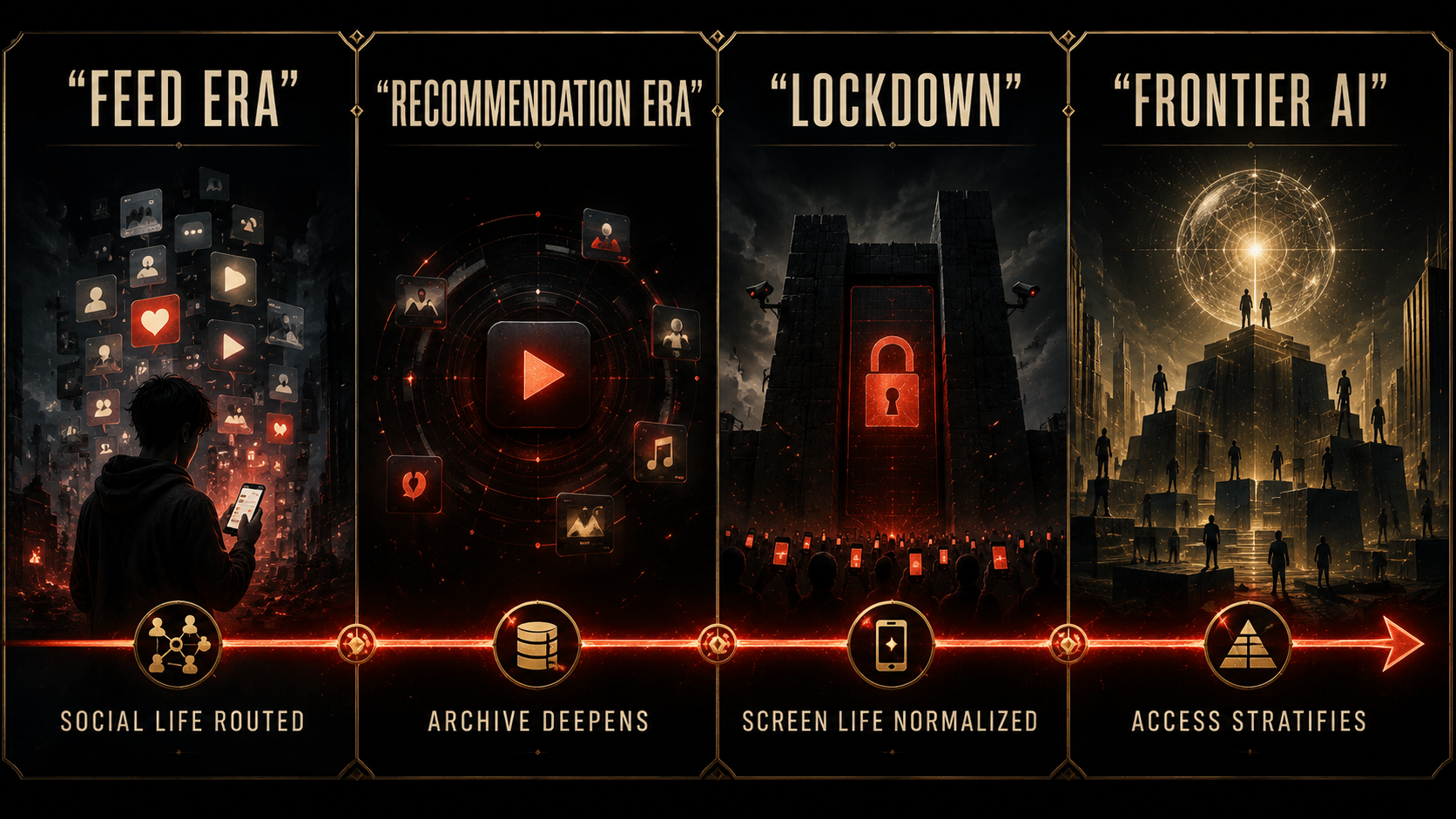
It also helped prepare the emotional climate into which the next AI wave would arrive. Think about the timing. By the time the public was being asked to accept synthetic assistants, automated summaries, machine-generated prose, and AI-augmented workflows as natural next steps, a huge share of society had already spent years learning how quickly life could be reorganized around remote mediation. The public mind had been softened for interface substitution.
That softening matters more than a lot of AI marketing admits. If a society has recently lived through a period where remote mediation felt unavoidable, then the next pitch lands differently. “Let the system help.” “Let the workflow adapt.” “Let the model summarize.” “Let the assistant absorb the friction.” Those offers sound less alien after years in which ordinary human continuity already depended on accepting technological substitution faster than anyone would have chosen under normal conditions.
That does not mean everyone liked it.
It means many people were preconditioned for it.
There is a difference.
The role of disputed origin narratives has to stay bounded here. The official record does not justify pretending the origin question is closed beyond debate. It also does not justify using that uncertainty as a trampoline for every totalizing geopolitical conclusion under the sun. The strongest use of the origin dispute in this book is not to settle the metaphysical question of who caused everything. It is to show that uncertainty itself became part of the atmosphere in which trust eroded, institutions polarized, and mediated life hardened.

That erosion matters because brittle trust and exhausted populations are easier to reorganize. Not in a comic-book mind-control sense. In the more ordinary and more dangerous sense that societies under stress become more willing to accept large technical systems as the price of continuity.
The world reopened unevenly.
But a lot of people did not return from the screen all the way.
Their friendships were thinner.
Their focus was worse.
Their work habits were more mediated.
Their tolerance for ambient platform dependence was higher.
Their archive was much deeper.
By then, the machine was closer to speaking than most people realized.
That is the turn this chapter is trying to catch. Not “COVID explains everything.” That is too easy and too sloppy. The sharper claim is that COVID made the social body more extractable, more screen-accustomed, more psychologically frayed, and more infrastructurally prepared for the next layer of AI normalization.
The world went inside.
The platforms were waiting.
And when the world came back out, it brought a larger archive with it.
This chapter adapts the documentary argument developed in the research paper Chapter 03: COVID as a Historical Accelerator. The PDF version is here. That paper separates documented pandemic effects, unresolved origin questions, and the broader structural case for digital acceleration.
By the time public life reopened, the question was no longer whether the archive existed. It was who would turn that archive into capability. The next chapter moves into the hinge of the whole book: how captured human life became training material, and how that material became power.
First they captured what we made. Then they captured how we think.

They did not build the AI god from nothing.
They built it from our searches, our books, our fan edits, our code commits, our forum fights, our memes, our DMs, our grief posts, our playlists, our horny late-night questions, our bug fixes, our lesson plans, our essays, our jokes, our documentation, our voice notes, our mistakes, and the endless trail of language we left behind because digital life had already become compulsory.
That sentence is doing a lot of work, so let’s slow it down.
The claim is not that every output from a model is a haunted copy of one person’s work.
The claim is not that weights are literal scrapbooks with names attached.
The claim is not that math itself is evil.
The claim is that frontier capability is downstream of mass human contribution, and the political meaning of that contribution was buried under the language of neutral computation for as long as possible.
This is the hinge chapter because it explains why social media, platform extraction, and AI cannot be treated as separate stories anymore. The earlier platform era created the conditions under which expression became massively collectible. The model era created the conditions under which that archive could be condensed into strategic capability.
That movement from archive to capability is the real scandal.
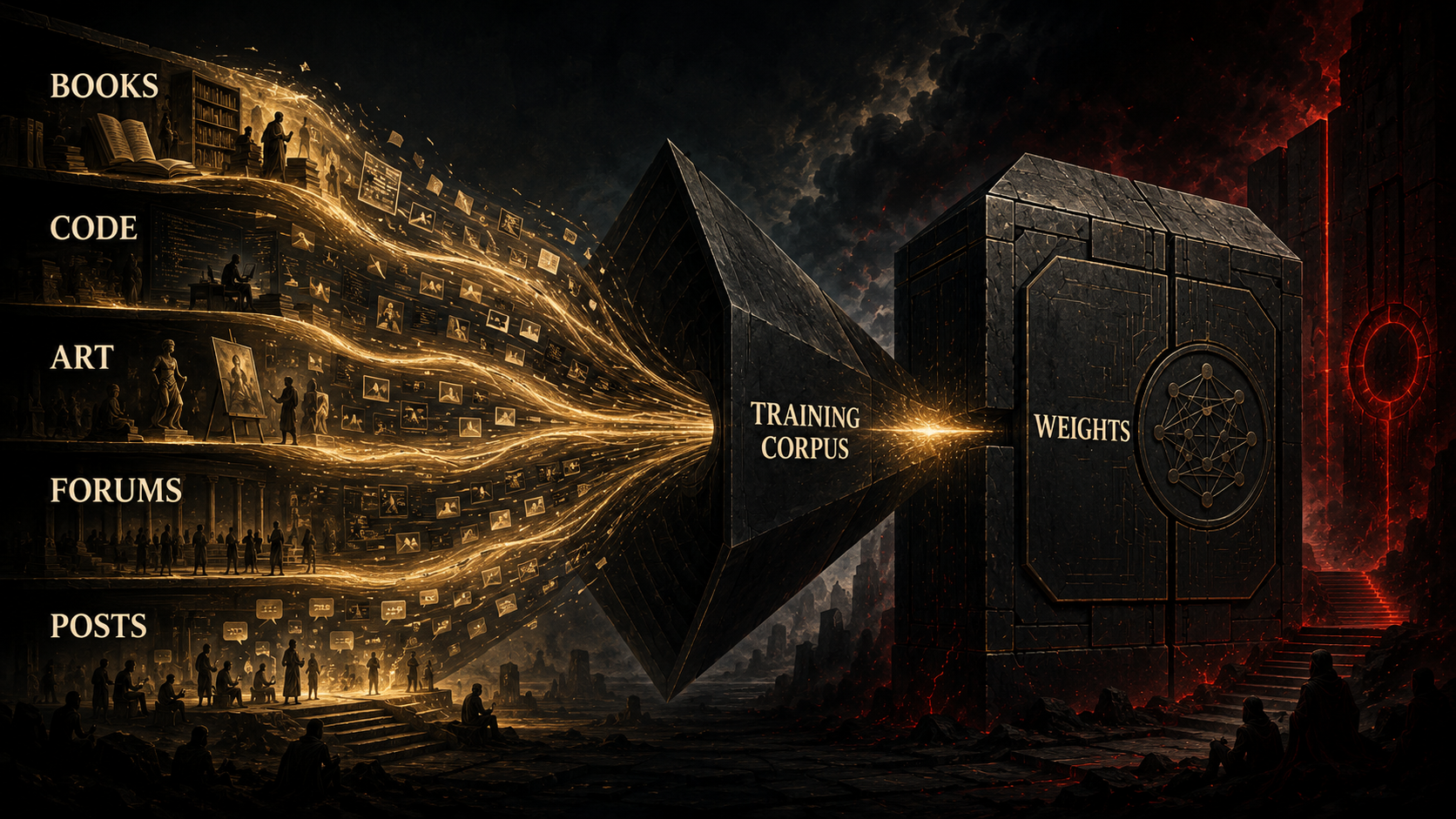
We tend to talk about data as if it were a warehouse category. Data sounds dry. Administrative. Kind of boring. But most of what mattered in the training explosion was not boring at all. It was human culture in active form. Speech, style, humor, expertise, taste, pedagogy, argument, intimacy, and craft. The machine got fluent because people were already pouring themselves into systems that could store the evidence of fluency at scale.
The quiet trick was that unpaid contribution had already been normalized long before most people cared about model training. Open a platform. Improve the answer thread. Fix the typo. Add the wiki note. Post the tutorial. Upload the review. Tag the image. Label the clip. React to the product. Answer the stranger. Build the open-source library. Debate the edge case. Explain the concept for free because someone somewhere might benefit. All of that felt like culture, community, or just ordinary internet life.
And it was.
But it was also substrate.

That is what changes once the model arrives. The same web that looked messy and alive from the human side starts looking like ingestible pattern from the machine side. Search becomes corpus. Conversation becomes training material. Creativity becomes signal. The messy abundance of public life becomes a commercially valuable precondition.
The industry likes to hide behind scale because scale makes responsibility blur. If something was trained on “the internet,” the phrase is vague enough to numb the moral imagination. But the internet is not a weather pattern. It is people. It is the sediment of people. Their work, their residue, their language, their unfinished explanations, their vulnerable performances, their expertise donated to strangers, their bad takes, their brilliance, their cringe, their labor, their obsession, their boredom, their care.
If a model becomes useful because enough people left enough of themselves behind in machine-readable form, then usefulness itself has a social debt baked into it.
That is where the legal and moral fight around weights becomes unavoidable.
The industry’s preferred framing used to sound something like this: models learn in a transformative way, they do not store the source like a zip file, and the output is not a one-to-one replay, so calm down.
That argument is not nothing. Some of it speaks to real technical distinctions. But it is also wildly incomplete as a moral theory. Because even if a weight is not a memory in the human sense, it is still a trace of exposure. It is still what remains when a machine has statistically internalized enough human material to produce synthetic competence. The exact legal status is contested. The social reality is not.
A frontier model does not emerge above civilization.
It emerges through civilization.
And that means the emotional experience of AI is not just wonder. It is estrangement. A lot of people meet these systems and feel two things at the same time: fascination at the fluency and a low, ugly recognition that something intimate was abstracted out of ordinary life and turned into strategic property. That is why so many creators, teachers, coders, and hyper-online workers feel not only threatened but weirdly gaslit. They are told the machine is just progress, while quietly recognizing fragments of the public world that made the progress possible.
That matters for creators first, but not only creators. Writers, artists, coders, musicians, teachers, forum contributors, researchers, volunteer moderators, documentation nerds, and just extremely online people all helped create the world the model could learn from. Some were paid by institutions. Many were not. A shocking amount of the internet’s most useful material was created by people who believed they were contributing to public culture, open knowledge, fandom, community, or personal visibility, not furnishing private power for the next intelligence hierarchy.
That is why the term patrimony becomes so important in the broader argument. Not because it sounds fancy. Because it names a category between “nobody owns this” and “a small number of firms get to own this completely.” If frontier capability is built from humanity’s collective archive, then treating the result as ordinary private property by default starts to look less like innovation and more like enclosure.
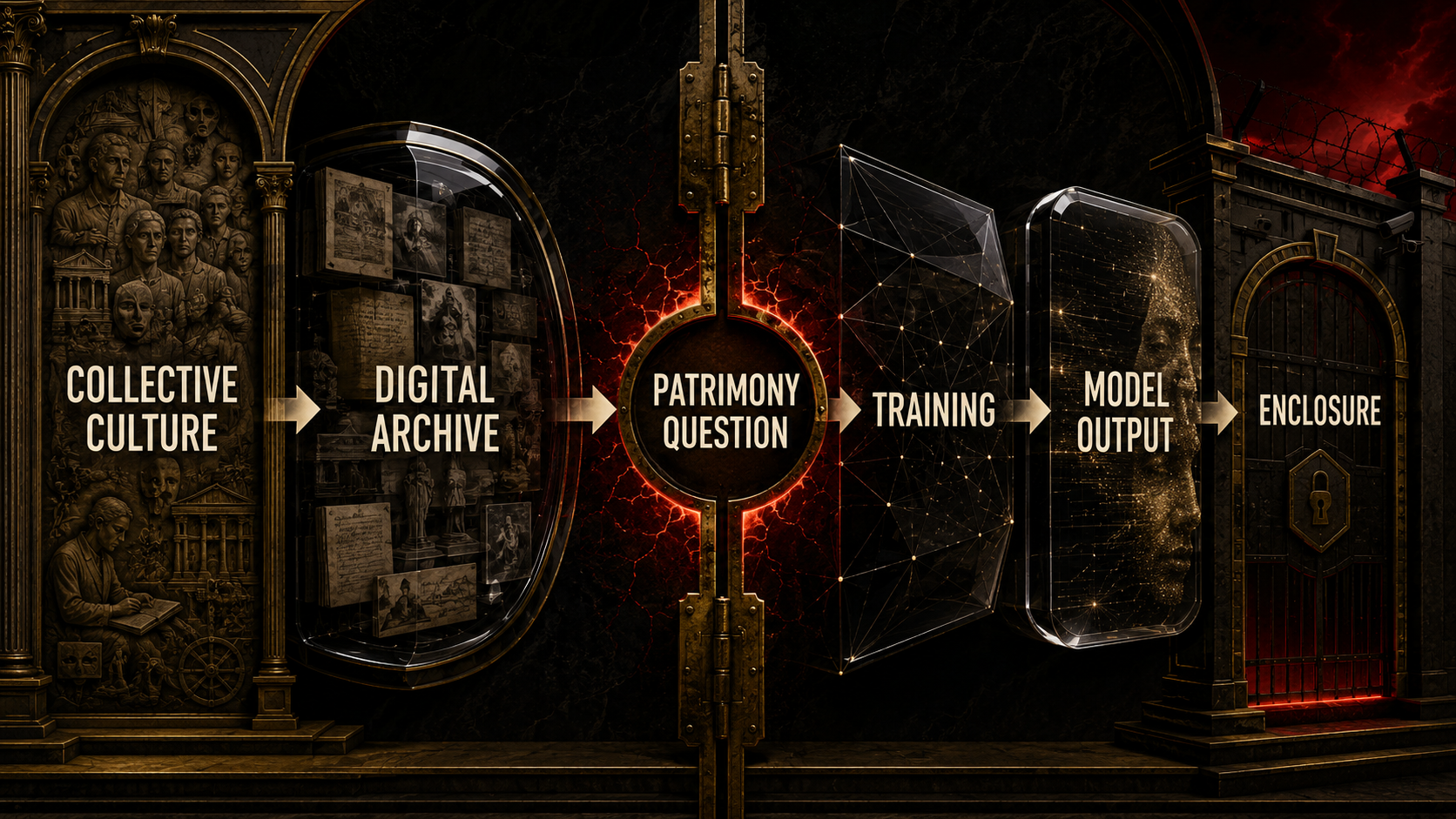
The politics of licensing complicate the story even further. Once the value of the archive becomes undeniable, firms start trying to regularize what was previously extracted under looser assumptions. This is where the Reddit example matters. A large social platform is no longer just a forum in this story. It becomes proof that collective human conversation can be enclosed twice: first as unpaid behavioral or cultural residue, then again as a licensable asset for model development.
That double enclosure is one of the ugliest moves in the whole cycle.
First the system convinces people to generate the field.
Then it convinces the world the field is a commodity.
Then it sells the field back as capability.
Then it tells the people who generated it that the resulting machine is progress and maybe also their replacement.
That is not a clean innovation story.
That is empire logic with better branding.
And it is not only an ownership story. It is also a shelf story.
Supermarkets did not need to invent the tomato. They needed to control the shelf where the tomato was sold. AI firms are learning a similar move with cognition. They do not need to outlive every artist, every programmer, every writer, or every expert in a pure merit contest. They need to become the first interface the customer reaches. The prompt box, the chatbot, the subscription layer, the clean white rectangle on the screen: that is the new shelf.
Once the shelf controls first contact, the value fight changes. Human work does not have to become worthless to become weaker. It only has to become easier to price downward. The creator is still there. The craft is still there. The judgment is still there. But the interface now stands between the creator and the customer, and that is enough to start renegotiating what the human on the other side is supposedly worth.
It is also why the politics of consent cannot be reduced to some fantasy of perfect individual opting in. Most people did not meaningfully negotiate with the systems that absorbed their residue. They lived, posted, coded, taught, uploaded, commented, revised, joked, and worked inside environments that had already become necessary for participation. “Consent” in that context often means something closer to procedural surrender. You click through because the social and economic world is already routed through the stack. Later, that routinized surrender gets reframed as if the archive simply existed, ownerless and ready for compression by whoever reached scale first.


This is also the chapter where the emotional tone of the book changes a little. Up to this point, a reader could still maintain some distance and think, okay, platforms got creepy, social life got weird, the pandemic accelerated bad habits, sure. But here the realization gets personal in a different way. The machine is not only around us. It is made from what we already gave away, often without understanding the end use, sometimes without a meaningful alternative, and almost never under conditions of real bargaining power.
That is why people feel a particular kind of insult when AI products are introduced as if they arrived through pure genius. Of course there is real engineering. Of course some technical leaps are genuine. But genius did not produce the archive. Society did. Users did. Workers did. Creators did. The culture did. The machine inherits the labor of the species and then reappears under a corporate logo.
Once you see that, the ownership question becomes impossible to dodge.
If human civilization was the training field, who should govern the resulting capability?
If the archive was collectively generated, should the output be permanently enclosed by whoever had enough capital and compute to compress it first?
If the public supplied the substrate, what obligations attach to the machine?
These are not abstract future questions anymore. They are already showing up in fights over copyright, licensing, model access, public funding, state partnership, and who gets to speak with the authority of synthetic intelligence.
The interpretation advanced in this project is not that current law has already settled the matter in favor of public patrimony.
It absolutely has not.
The interpretation is that the law is lagging a moral reality that is already visible: weights built from collective human expression should not simply inherit the default moral status of ordinary proprietary assets.
That is not anti-technology.
It is anti-enclosure.
And unless that distinction becomes politically legible, the next phase of the AI economy will keep repeating the same move: privatize what was socially produced, then market access to it as destiny.
This chapter adapts the documentary argument developed in the research paper Chapter 04: AI Arrives When the Human Raw Material Already Exists. The PDF version is here. That paper grounds the weights debate in Copyright Office records, memorization research, licensing developments, court conflict, and the social-to-model bridge.
Once the archive becomes commercial capability, the next fight is not only about creators. It is also about workers. The same industry that learned from human labor started using AI rhetoric to weaken that labor, reorganize it, and call the whole process inevitable.
The machine did not only learn from workers. It was used to discipline them.

The same industry that spent years treating elite technical workers like golden blood suddenly found a very different vocabulary for them the moment the market tightened.
Not builders.
Headcount.
Not talent.
Cost centers.
Not the future.
Excess.
Not family.
A line item.
If you worked in or around tech during that shift, you could feel the betrayal almost before you could explain it. The vibes changed first. Then the language changed. Then the org charts changed. Then people disappeared.
One week it was founder talk, mission talk, future talk. The next week it was nervous Slack threads, recruiter rumors, vague calendar holds, and the weird quiet that hits an office when everybody already knows the spreadsheet has started deciding who counts.
One of the cleanest lies of the AI era is that the layoffs were simple proof that the machines had already made people obsolete. It is a neat story, which is exactly why capital liked it. But the documentary record is messier than that, and the mess is the point.
The correction was already forming.
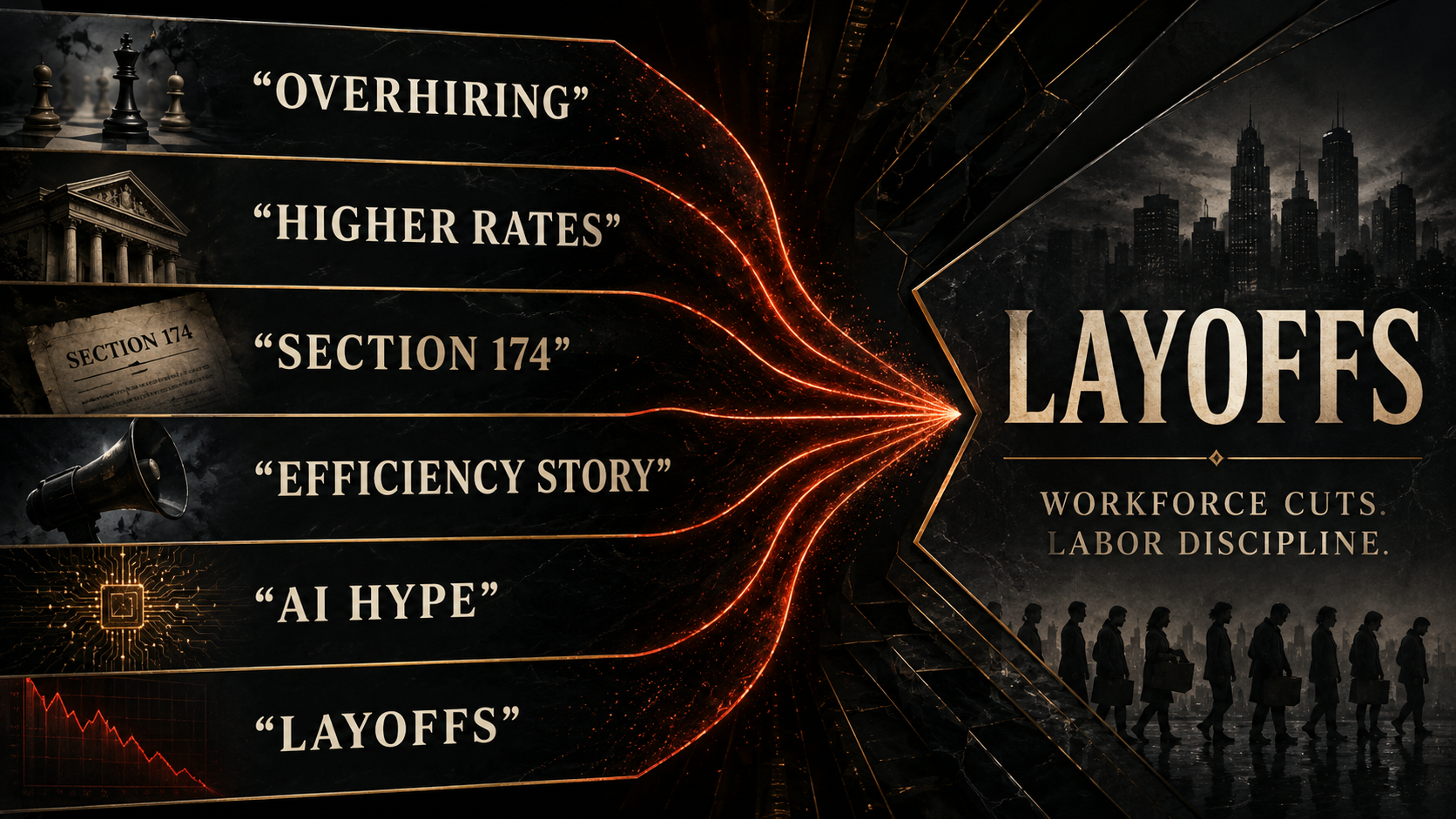
Post-pandemic overhiring mattered.
Interest-rate pressure mattered.
Margin anxiety mattered.
Investor demands mattered.
Tax treatment changes such as Section 174 mattered.
The entire vibe shift from growth worship to efficiency worship mattered.
AI did not create all of that from zero.
AI gave it a sacred language.
That language was wildly useful because it turned a financial and strategic correction into a civilizational necessity. Once executives could say “we are reorganizing for the AI future,” the cuts started sounding visionary instead of extractive. Once a company could claim it was flattening teams, driving efficiency, or reallocating toward intelligence infrastructure, the human cost was wrapped in inevitability language.
That is why the word ritual fits. A ritual is not just an event. It is an event arranged to teach everyone something. The layoff wave taught workers several lessons at once.
First: your talent is celebrated when growth needs your aura.
Second: your security evaporates when the macro story changes.
Third: a machine trained partly on the digital world you helped build can be invoked rhetorically against you whether or not it has literally replaced you in any clean technical sense.
That third lesson is one of the ugliest in the whole book. The same ecosystem that harvested human labor, open knowledge, collective code, and community-built expertise suddenly discovered the strategic value of telling workers that their bargaining position had weakened because intelligence itself was being automated. Sometimes there was a real productivity shift underneath that claim. Often there was also narrative theater doing a lot of heavy lifting.
The theater matters because it disciplines the surviving workforce even when no full replacement has happened yet. If everyone around you is being told that AI is the next productivity baseline, then the meaning of your own labor changes even before your job does. You are expected to output more, faster, with fewer people, while the company claims it is simply adapting to the future.
That does something to worker psychology.
It narrows negotiation.
It weakens solidarity.
It makes resistance feel old-fashioned.
It makes management sound like history itself.
And because so many younger workers had been taught to treat tech not just as employment but as identity, the hit landed deeper than a normal recession story. The industry had sold a whole emotional package with the paycheck: the mission, the campus, the perks, the myth that shipping fast meant living at the frontier. Then the frontier started talking back in cost-accounting language.
And because so much of the sector spent years mythologizing technical labor as the engine of everything, the reversal hit with a particularly disorienting force. Engineers were not only employees in this story. They were social symbols. They were the proof that the future had prestige, that software had winners, that intelligence still had upward mobility attached to it. Then, when the correction arrived, the symbolism snapped.
Suddenly the worker was not the future.
The worker was drag on margin.
That is not the whole story, of course. Some firms were genuinely bloated. Some teams were real duplicates. Some pandemic-era hiring waves were unsustainable in obvious ways. The point of this chapter is not to romanticize every role or deny that labor markets swing. The point is to stop accepting the flattering lie that the cuts can be fully explained as purely technical progress.
They cannot.
Part of what made the story so effective was that it contained enough truth to move fast. Yes, some automation tools were improving. Yes, some companies had hired like zero-rate euphoria would last forever. Yes, some orgs were padded. But that is exactly why the narrative worked: it compressed multiple causes into one clean moral signal. The future belongs to leaner firms and machine-assisted output, so anyone questioning the cuts can be framed as arguing with reality itself.
The causal picture is layered:
financial correction,
tax treatment pressure,
capital-market discipline,
post-pandemic normalization,
efficiency language,
and then AI as legitimizing narrative layered on top.
That layered explanation is more uncomfortable than the simple one because it reveals how power works in grown-up markets. The machine does not need to fully replace the worker to lower the worker’s leverage. It only needs to become believable enough as a management story.

This is also where Section 174 matters in a way normal public discourse almost never explains well. The rule change did not magically cause every layoff by itself, and pretending it did would be sloppy. But it did change how software and research spending hit the books, which matters in a sector addicted to growth optics and investor signaling. If labor once looked like expansion, parts of that same labor could suddenly look like a cleaner thing to rationalize, defer, or cut. In plain English: accounting pressure met macro pressure, then got narrated through efficiency language that was unusually easy to fuse with AI hype.
And when that fusion happened, workers were asked to internalize the logic as common sense. Be grateful you are still here. Learn the tools faster. Ship more with less. Treat the shrinking team as proof of strategic maturity. Pretend the sprint did not just become a slow emergency. A whole generation of technical workers got a brutal education in how quickly “the future” turns on labor once capital decides the valuation story needs a new costume.

That is the real weaponization of inevitability.
The machine becomes an alibi before it becomes a total substitute.
And for middle-class technical workers, that alibi is politically important because it shows how quickly a sector can move from talent hoarding to labor disciplining once valuation logic changes. Companies do not only hire because they need the exact current output. Sometimes they hire to capture strategic labor, defend market position, signal momentum, and build the story that justifies extraordinary valuation. When that story changes, the same surplus labor that once inflated prestige becomes the easiest thing to cut.
Workers experience the fall emotionally.
Finance experiences it narratively.
AI helped close that gap.
It let boards, executives, and markets say: this is not simply retrenchment. This is modernization.
That word did serious ideological work. Modernization sounds clean. Mature. Inevitable. Like no one made a choice and history just showed up with a knife. But what many workers actually lived through felt less like elegant modernization and more like class discipline in premium branding: fewer people, more output, more pressure, more internal AI mandates, more expectation that one person should now carry what used to be one-and-a-half jobs.
That claim will keep showing up unless readers learn how to hear it properly.
Modernization for whom?
Efficiency for whom?
Productivity against which denominator?
Innovation at whose cost?
When a firm that benefited from a decade of elite technical labor suddenly starts talking like labor itself is a transitional inconvenience, that is not just strategy. It is class reordering under high-status language.
That matters because the future of AI is not only a story about consumers and creators. It is also a story about the technical middle class. The people who built systems, shipped products, made infrastructure legible, staffed teams, documented knowledge, trained juniors, and held together modern software organizations are being told in real time that the very abstraction layer built from collective digital life now justifies doing more with less.
The insult is historic.
But it is also clarifying.

It reveals where ownership sits.
It also reveals the labor logic of technofeudalism. The serf matters until the lord finds a lower-friction way to extract the harvest. In the digital version, elite labor is praised while it is scarce, strategic, and valuation-friendly. Then, once enough code, enough process, enough documentation, and enough machine leverage accumulate, the same labor is told to accept weaker security in the name of progress. That is not a glitch in the story. It is the story.
For readers outside tech, this chapter matters because the pattern does not stay inside engineering orgs. It leaks outward into copywriting, design, support, teaching, analysis, journalism, legal prep, translation, and all the middle layers of knowledge work. The prestige version shows up first in software because software had the capital and the mythology. The discipline mechanism spreads later. What gets tested on engineers today gets marketed to everyone else tomorrow as the responsible way to live with AI.
This chapter adapts the documentary argument developed in the research paper Chapter 05: Talent, Overhiring, Valuation, and Layoffs. The PDF version is here. That paper ties labor correction to financial structure, Section 174, post-pandemic excess, company efficiency language, and the strategic use of AI rhetoric.
Once AI becomes a labor-disciplining story, it can also be sold in two voices at once: dangerous enough to change history, friendly enough to place in every workflow. The next chapter follows that contradiction.
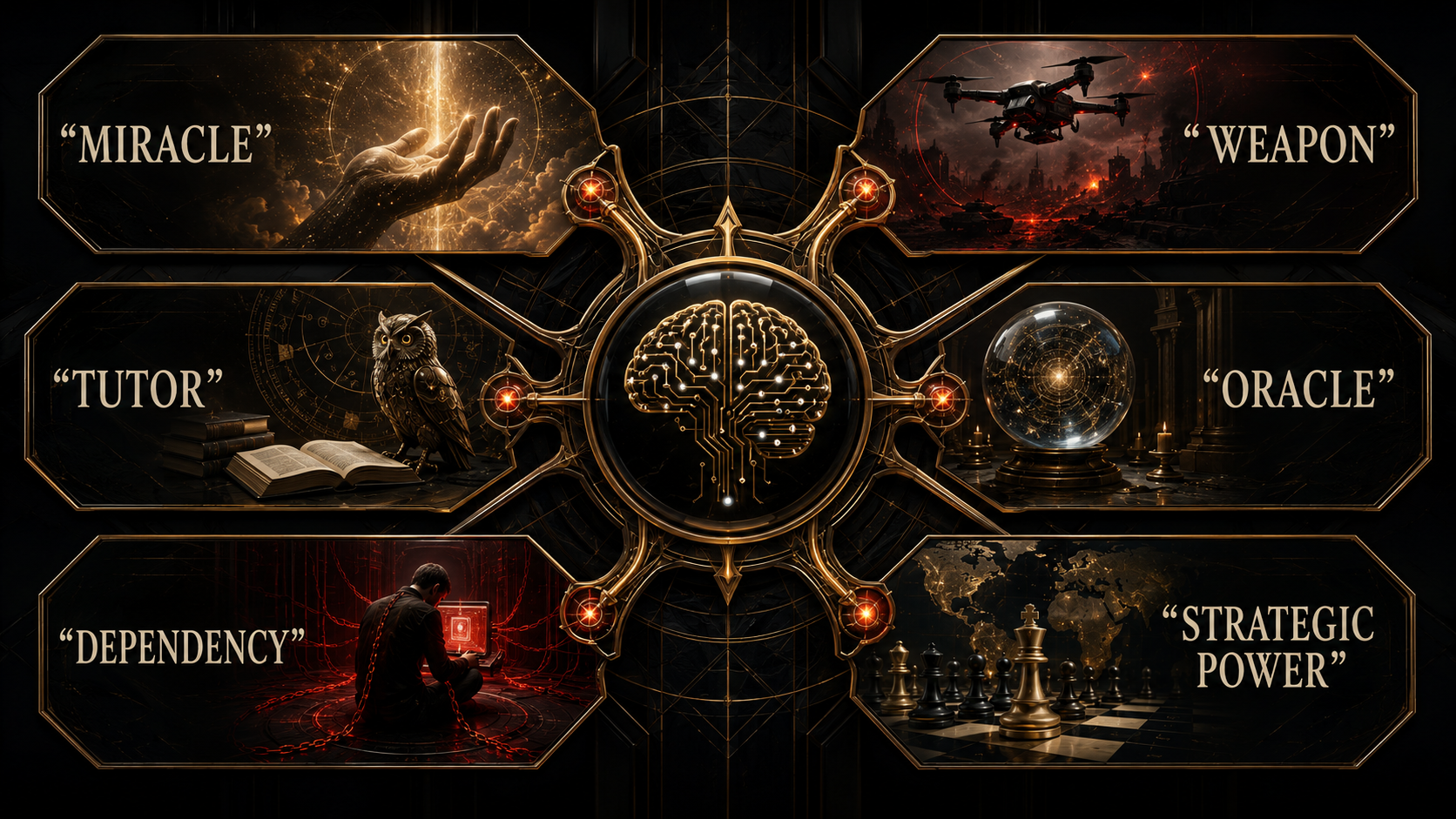
How the same system is sold as miracle, weapon, tutor, oracle, and dependency engine.

The public is told two things at once.
AI is dangerous enough to alter labor markets, war, politics, education, creativity, and the structure of knowledge itself.
AI is also convenient enough to place in your email, your browser, your therapist app, your homework flow, your coding workflow, your search box, your customer service line, your government paperwork, and your daily life with almost no friction.
Those two messages are not separate.
They are the business model speaking in stereo.
The first message produces awe.
The second message produces habit.
Awe gives the system prestige.
Habit gives it surface area.
That is why AI enters culture with such a strange energy. It is sold like a moon landing and adopted like a browser plugin. One minute the language is civilizational. The next minute the same system is folded into homework, coding, flirting, note-taking, venting, and search as if it were just another convenience patch for a tired population.
Together they create dependence fast enough that the public often starts using the tool long before it has a stable political language for what the tool is, how it was built, who governs it, or why certain firms are allowed to narrate both the danger and the salvation at the same time.
That is why this chapter uses the word gospel. Not because the systems are literally religious. Because they are marketed through a blend of warning, promise, inevitability, and submission. Respect the power. Use the power. Fear the power. Trust the power. Build on the power. Don’t ask too many annoying structural questions while integrating the power into your workflow.
The contradiction is doing real work.
If AI is framed as epochal, critics can be made to sound small-minded or unserious.
If AI is framed as cheap, friendly, and already everywhere, resistance can be made to look impractical.
That is a powerful one-two punch.
It turns political argument into cultural lag.
And because some technical progress is genuinely real, the rhetoric never has to be totally fake to become manipulative. That is important. This chapter is not anti-progress cosplay. It is not pretending every advance is smoke. The point is subtler and more useful: real progress can still be packaged in ways that normalize enclosure, hide subsidy, flatten complexity, and train the public to confuse access with empowerment.
The cheapness story is a good example. Public discourse often swings wildly between “AI is going to remake civilization” and “AI is basically free, just use it.” But systems that consume massive infrastructure, talent, energy, and strategic investment are not magically cheap in a deep economic sense just because a consumer tier is subsidized or underpriced in a race for habit formation. A thing can feel cheap at the user interface while remaining brutally expensive in the political economy that sustains it.
That is why the phrase circular economy keeps floating around the edges of this project. There are moments when the AI story starts sounding less like normal market efficiency and more like a coordinated burn to buy dependency, justify valuation, and reposition labor. The system is introduced as lower-cost than humans. Then, once habit deepens and the hierarchy stabilizes, the real cost structure becomes harder to ignore. The subsidy phase and the power phase are not the same phase.
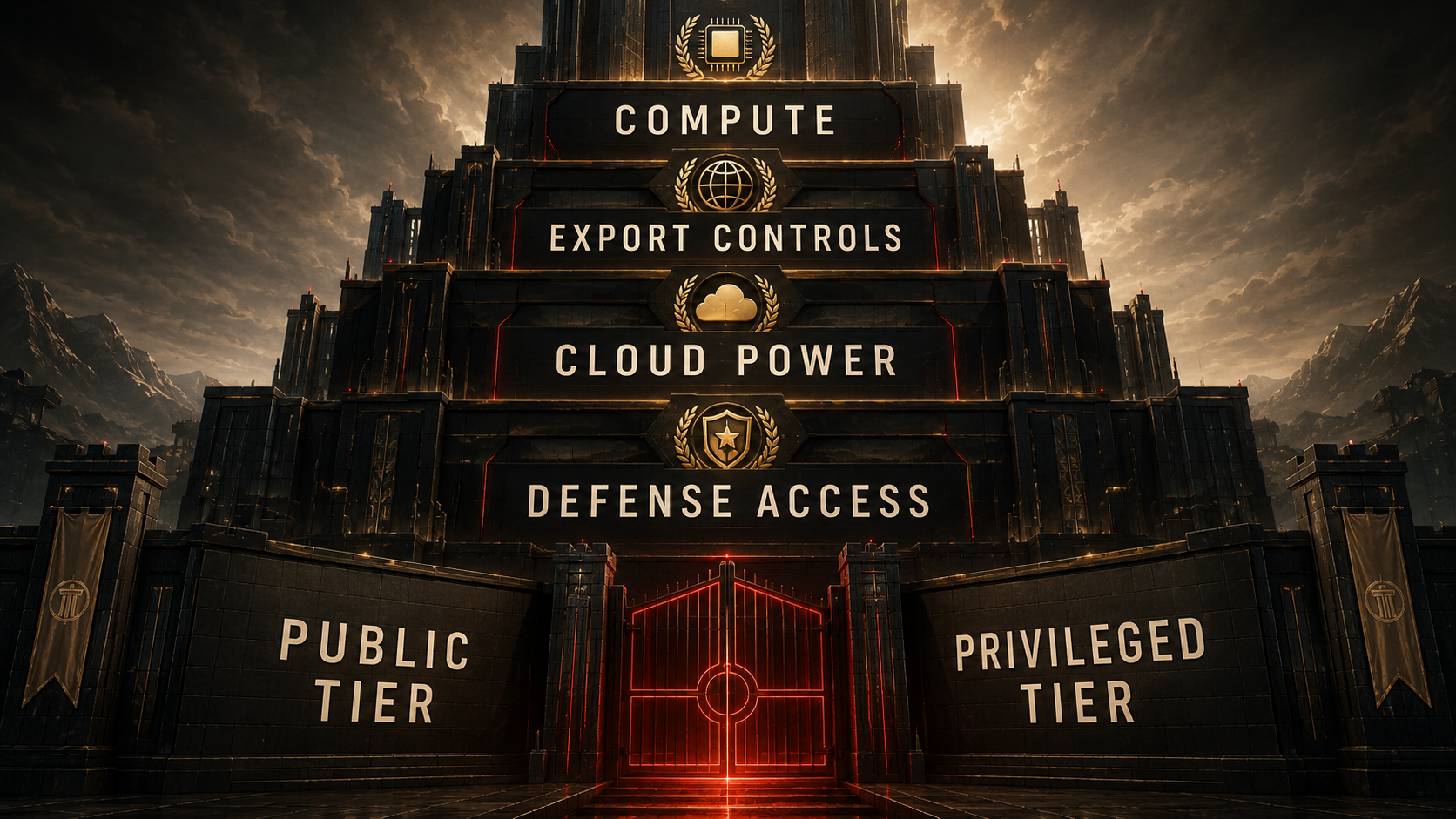
You can already feel this at the culture level. The entry tier is framed like abundance. Try it. Draft faster. Search smarter. Think with the machine. But the social architecture around that cheapness points in another direction entirely: premium tiers, enterprise gates, private compute, privileged models, proprietary integrations, and the quiet normalization of the idea that better cognition itself will arrive in ranked subscription form. The assistant sounds democratic at the front door while the serious stack hardens into hierarchy in the back.

This is where a lot of younger users get emotionally cornered. They are not dumb. They can feel the relief. They know the tool helps. It unblocks drafts, kills blank-page panic, speeds up ugly admin work, and gives overstretched brains a place to throw first-pass thinking. But usefulness is exactly what makes enclosure sticky. If the system genuinely helps while also deepening dependence on a privately governed stack, critique starts sounding to exhausted people like a request to suffer on purpose.
The reasoning boom has to be heard through that same skepticism. Yes, some systems have gotten better at longer-chain task handling and more explicit structured inference. But the public-facing story often treats “reasoning” as if it were a clean metaphysical leap instead of a mix of real progress, packaging decisions, and product framing. The point is not to deny the gains. The point is to resist worship vocabulary when the same capabilities are still governed by the same private structures.
Use the tool, sure.
But don’t start kneeling because it got better at showing its work.
That line matters because a tired public is extremely vulnerable to competence theater. If you have been overworked, underfocused, under-rested, and algorithmically fragmented for years, a system that responds in calm paragraphs can feel almost sacred. It can feel like the first room in a long time where somebody is not shouting. That emotional effect is real. It is also politically dangerous when the calmness of the interface distracts from the ownership of the stack behind it.
That warning matters because the reasoning boom has a pseudo-spiritual edge to it. The machine now seems not just fast but patient, layered, almost contemplative. A public whose attention was already shredded by the feed is then invited to encounter a polished synthetic reasoner and feel gratitude, trust, maybe even reverence. The same ecosystem that helped wreck concentration gets to sell the patch for wrecked concentration.
That warning matters because many users are now being trained to relate to AI not just as software but as ambient authority. Ask it for a plan. Ask it for judgment. Ask it for emotional translation. Ask it to summarize the world because your own attention has been shredded by the systems that also normalized the AI layer. That is one of the darkest loops in the whole book: the feed weakens attention, then the model arrives as the helper for the damage the feed helped create.
The oracle shows up after the altar has already done its work.
That is why the public rhetoric of danger can be so politically useful even when it is sincere in parts. A system described as profound, risky, transformative, and civilization-scale can claim extraordinary deference. It can also argue for exceptional access control, exceptional legal latitude, exceptional talent capture, exceptional government attention, exceptional investment multiples, and exceptional patience from the public.
Then the convenience layer makes that exceptionalism feel normal.
This is what the dual-use gospel sounds like in practice:
“This technology is too important to regulate clumsily.”
“This technology is too dangerous to distribute openly.”
“This technology is too useful for you not to adopt immediately.”
“This technology is too inevitable for workers to resist.”
“This technology is too advanced for outsiders to question deeply.”
Those claims do not always come in one speech, but they reinforce one another.
And the public, already exhausted and cognitively overloaded, often meets them in the most disarmed state possible: by trying the tool before understanding the doctrine.
That disarmed state is the market opportunity. By the time a society begins asking whether the stack is too concentrated, too subsidized, too extractive, or too entangled with public power, millions of people may already feel they cannot write, search, code, study, or plan in quite the same way without the system nearby. Dependence arrives socially before constitutional language arrives politically.
That is how the habit outruns the politics.
That is how dependence outruns judgment.
That is how the machine enters daily life while the deeper argument is still being treated like an optional think-piece problem for specialists.

The book is pushing against that passivity. Not by telling readers to reject every AI tool on sight, but by insisting that convenience is not innocence. A frictionless interface does not absolve an extractive training story. A friendly tone does not dissolve the ownership problem. A subsidized product tier does not prove a healthy underlying economy. A more impressive reasoning demo does not automatically justify who controls the reasoning stack.
The machine may become ordinary in use.
It should not become ordinary in scrutiny.

That is the emotional trick this chapter wants readers to catch in real time. The system becomes easiest to question precisely when it becomes hardest to imagine living without. That is the point at which convenience stops being just convenience and becomes political conditioning. You are no longer merely using a tool. You are rehearsing a social future in which machine mediation is assumed first and human fallback comes second.
Because once a population starts treating private machine mediation as normal weather, the harder questions lose oxygen fast. Who pays for the subsidy phase? Who gets the better versions? Who absorbs the labor pressure? Who can inspect the stack? Who benefits when people start confusing dependence with efficiency? Those are not anti-technology questions. They are the minimum adult questions a society should ask before it starts calling a new dependency inevitable.
This chapter adapts the documentary argument developed in the research paper Chapter 06: AI as a Dual-Use Rhetorical Weapon. The PDF version is here. That paper distinguishes real progress from strategic packaging and follows the collision between danger rhetoric, cheapness rhetoric, and reasoning politics.
Once the public is habituated, the deeper question emerges: who actually controls the serious access layer? The next chapter leaves the product story behind and walks up to the gate.
Compute, export controls, and defense alignments decide who may approach the new oracle.

In the old empire, power wanted the ports, the roads, the steel, the trade routes, the army, the sea lanes, the oil.
In this one, power still wants plenty of that.
But now it also wants the chips, the cloud, the compute clusters, the export controls, the model endpoints, the government-only environments, the defense channels, and the right to decide who gets close to advanced intelligence and on what terms.
That is the moment when AI stops looking like a fun product category and starts looking like strategic territory.
A lot of public conversation about AI is still stuck at the consumer layer. Which chatbot is faster. Which model is cheaper. Which app summarized your meeting. Which assistant vibes more human. That layer matters because it shapes habit, but it can also hide the harder truth: consumer access is not the same thing as power.
The easiest way to say it is this: getting a freemium balcony seat is not the same as holding the keys to the theater. A public interface can be massively popular and still leave the real leverage somewhere far above the crowd, in rooms most users will never see and cannot vote on.
You can hand millions of people a public interface and still reserve the meaningful leverage somewhere else entirely.
That somewhere else is the gate.
The gate is made of compute concentration.
The gate is made of cloud dependence.
The gate is made of export-control politics.
The gate is made of government contracts.
The gate is made of who gets a frontier deployment, who gets a sovereign environment, who gets inside the policy room, who gets the classified variant, who gets to help define “safe” access, and who gets told that a friendly consumer product is close enough to participation.
This is where the word imperial stops sounding melodramatic and starts sounding descriptive. We are no longer dealing only with open competition among ordinary software vendors. We are dealing with an ecosystem where the ability to approach the most powerful systems is increasingly filtered through chokepoints that are technical, financial, political, and geopolitical all at once.
Some firms own or control key model layers.
Some cloud giants control distribution terrain.
Some governments control licensing, export, and security framing.
Some defense channels create privileged operational pathways.
And everyone below that stack is encouraged to believe that broad consumer exposure equals democratic access.
It doesn’t.
That is one of the defining illusions of the whole era.
If a consumer gets a model in their browser while states, defense structures, hyperscalers, and a tiny number of frontier firms sit at the level where strategic access is decided, then the public has interface access, not sovereignty.
That distinction matters because intelligence is becoming infrastructure. Not total infrastructure, not the only thing that matters, but a genuine layer of future coordination, labor, administration, and competitive advantage. If that layer is tiered, governed, and selectively distributed, then the politics of access become as important as the politics of invention.
That is where the chapter stops sounding like product criticism and starts sounding like geopolitical realism. Once intelligence becomes tiered infrastructure, the central question is no longer just who invented what first. It becomes who can deny access, who can create privileged lanes, who can call an emergency and get special treatment, who can integrate at scale, and who is expected to stay grateful for whatever version reaches the public tier.

The language around safety often gets weirdly useful here. Safety can be a real concern. It can also become a sorting mechanism. Strategic risk can justify genuine caution. It can also rationalize privileged control. Export controls can reflect real geopolitical competition. They can also crystallize the fact that frontier AI is already being treated not as ordinary consumer software but as a strategic resource whose circulation must be managed.
That is the core turn this chapter wants the reader to feel.
The “AI boom” is not just a market.
It is a border regime in the making.
Some people will get mass-market access.
Some institutions will get premium proximity.
Some companies will get infrastructure intimacy.
Some states will get strategic channels.
Some populations will supply the substrate while staying far from the control layer.
Once you see that, a lot of the rhetoric around openness starts sounding like branding for a staircase.
You get the lower steps. You get the demo, the endpoint, the API tier, the sense that you are close enough to the miracle to count as included. Meanwhile the upper levels, where compute allocation, sovereign environments, export permissions, and security-framed deployment choices are made, remain heavily guarded and thinly democratized.
One of the traps here is to jump immediately into hidden-mastermind storytelling. The stronger case does not need it. The formal record is already loud enough. Compute concentration is real. State-company coordination is real. Defense offerings are real. Export control is real. Government-only deployment pathways are real. Cloud dependency is real. None of that proves omnipotence. It proves hierarchy.
And hierarchy is enough.
Hierarchy is enough to reshape research tempo, state capacity, labor markets, and international dependency. It is enough to determine which countries buy power and which rent it, which institutions build competence and which lease it, which publics can audit systems and which are expected to clap from the outside.

This is also where the moral stakes of access become visible in everyday terms. If advanced models increasingly mediate productivity, research acceleration, coding assistance, bureaucratic throughput, and strategic planning, then unequal access to those layers can compound preexisting inequality fast. The gap is no longer just money or education in the old sense. It becomes mediated intelligence proximity.
Who gets the best tools?
Who gets the fastest inference?
Who gets the safest hosting?
Who gets the deployment environment with the fewest restrictions?
Who gets to fine-tune at scale?
Who gets to shape the rules everyone else must accept?
The answer, unless the structure is contested, will not be “everyone.”
And that is why the anti-capture reform at the end of this book matters so much. If AI firms benefit from public contracts, strategic access, national-security intimacy, subsidy-like advantage, or privileged state alignment, then their obligations cannot remain private-company-light while their leverage becomes civilization-scale. A firm this close to the gate of intelligence cannot keep pretending it owes the public nothing except product polish and a trust-me blog post.

This chapter is not about hating innovation. It is about refusing the fairy tale that the frontier is a neutral commons just because a public demo exists. Empires love demos. Demos keep the crowd impressed while the fortifications harden somewhere else.
So yes, use the public interface if you want. Study it. Learn it. Critique it. Build around it when necessary. But do not confuse being let into the gift shop with being allowed near the control room.
That confusion is how a hierarchy normalizes itself.
And once it normalizes, the next move is predictable: the winners stop sounding like vendors and start sounding like custodians of destiny. That is where the story goes next, because raw concentration is unstable until elite society decides to praise it.
This chapter adapts the documentary argument developed in the research paper Chapter 07: Imperial Control Over Access. The PDF version is here. That paper grounds the access story in compute chokepoints, government offerings, defense channels, export-control politics, and documented state-company interfaces.
But gates alone do not secure an empire for long. The system also needs admiration, trust theater, elite prestige, and institutional blessing. The next chapter follows the machinery that turns concentration into legitimacy.
The empire does not survive by code alone. It survives by praise, access, prestige, and institutional blessing.

Power wants to be admired before it is resisted.
It wants the glowing profile before the hearing.
It wants the summit stage before the subpoena.
It wants the policy dinner, the university panel, the prestige podcast, the careful magazine spread, the vocabulary of concern that teaches everyone else which power is supposed to feel too sophisticated to doubt.
That is why frontier AI firms do not only build models.
They build boards.
They build policy lanes.
They build safety language.
They build philanthropic halos.
They build relationships with governments, universities, think tanks, defense structures, media institutions, and the kinds of symbolic authorities that teach the public which concentrations of power are dangerous and which are visionary.
The machine is not enough by itself.
The machine also needs a story.
This is the layer where concentration learns how to smile.
The extraction story is still there.
The enclosure story is still there.
The labor-disciplining story is still there.
The access hierarchy is still there.
But on the surface, the tone changes. The firms begin speaking in the language of stewardship, humanity, safety, alignment, democratic concern, public benefit, and civilizational responsibility. Some of that concern may be real at the level of individual belief. But structurally, it also does something else: it stabilizes contradiction long enough for power to harden.
That is what legitimacy is doing here.
It lets firms say they fear concentrated power while continuing to accumulate it.
It lets state intimacy appear as responsibility rather than capture.
It lets elite praise flatten popular suspicion.
It lets extraordinary private control wear the costume of reluctant guardianship.
And because the products themselves really are impressive enough to create awe, the narrative machine does not have to work from nothing. It only has to attach prestige to concentration before the public fully absorbs what concentration means at this scale.
This chapter has to keep its discipline, especially around people and scandal. There is always a temptation, in work like this, to turn orbiting personalities into the story itself. To collapse structure into gossip. To imply guilt through adjacency because adjacency makes the writing feel hotter. The dossier rule is the opposite: no guilt by association, no lurid substitution for real institutional analysis, no naming that outruns relevance.
That is not restraint because the subject is soft.
It is restraint because the structural case is stronger.
The stronger case says this: when a small number of frontier firms can move through lobbying channels, public-benefit language, state partnerships, defense adjacency, philanthropic legitimacy, future-of-humanity rhetoric, and even moral or religious prestige fields, they cease to look like ordinary market actors. They start to look like aspiring custodians of public intelligence infrastructure without corresponding public accountability.
That is what makes the legitimacy field dangerous.
Not that it is fake in a cartoonish sense.
But that it blends real concern, genuine talent, elite access, and institutional self-interest into a permission structure that is easy for the broader public to misread.
The permission structure matters because most people do not audit power at the source level. They infer legitimacy from context. If respected newspapers interview the founders like tragic geniuses, if public institutions invite them into the room, if universities flatter them, if philanthropic narratives cast them as guardians, if policy circles treat them as indispensable adults in the room, then private concentration begins to feel less like a threat and more like a burden these firms nobly carry on behalf of everyone else.
That is respectability laundering at civilizational scale. Not because every actor involved is cynically coordinated, but because prestige compounds. One panel, one fellowship, one award, one pulpit, one carefully staged conversion story at a time, the enclosure stops looking like enclosure and starts looking like stewardship.
This is why governance theater matters so much. A public-benefit label, a safety board, a moral advisory frame, a prestigious summit appearance, a promise to donate wealth, a careful partnership announcement with state or civil institutions, even a high-minded warning about how powerful the technology is becoming: none of these things are meaningless, but none of them settle the underlying power question either. They can just as easily function as soft architecture around concentration, especially when outsiders are so dazzled by capability that they start treating symbolic restraint as equivalent to structural accountability.
And then there is the moment when the stated preference and the revealed preference stop matching. Publicly, the stewards of the new intelligence order speak in the language of responsibility, humanity, and collective future. Privately, some of the same elite circles invest in retreat property, underground shelters, backup jurisdictions, private security logic, and the material possibility of getting out. That does not prove they are plotting collapse. It does not prove a secret command center behind history. But it does reveal something ugly about the social contract they are asking everyone else to accept. If the future is good enough for the public only with private blast doors in reserve, then legitimacy starts to curdle. Call that the bunker class if you want. The point is not the bunker. The point is the exemption.


That is how myth hardens around infrastructure.
And because AI is now linked to civilizational language more than most recent technologies were, the myth can get especially grand. The machine is not just useful. It is historic. Not just profitable. Necessary. Not just powerful. Maybe humanity’s next decisive layer. Once firms are allowed to sit inside that register without robust public challenge, their private decisions start acquiring the emotional aura of quasi-public destiny.
That is a huge transfer of authority.
And it is one that many liberal institutions are oddly vulnerable to because the language of responsible stewardship sounds so much nicer than the language of empire.
That vulnerability is cultural as much as procedural. A lot of elite institutions desperately want to believe that concentration becomes acceptable when the concentrated actor sounds self-aware enough. Give power the right vocabulary and half the room relaxes. Say alignment. Say responsibility. Say existential caution. Say democratic concern. Say public benefit. Say safety. The terms are not meaningless, but they can function like liturgy when the audience wants reassurance more than redistribution of power.
That is why the religious metaphor in this project matters even when it stays metaphorical. Nobody has to literally worship the machine for institutional behavior to start looking devotional. All it takes is a class of people willing to treat proximity to capability as moral seriousness, and to confuse a refined tone with legitimate ownership.
That is why public-benefit conversion stories, board restructuring stories, or future-of-humanity language cannot be judged by rhetoric alone. They have to be read against material control. Who still owns the capability? Who still sets access rules? Who still governs model deployment? Who still benefits when the system scales? A vocabulary of care attached to a structure of enclosure does not become justice just because the press release sounds morally literate.
That is the move a lot of smart audiences still underestimate. In the platform era, power often tried to look casual. Founder in a hoodie. Disruption as personality. Move fast and pretend the damage is just a side effect of genius. In the frontier-AI era, power is learning to look solemn instead. More cathedral, less dorm room. More “guardianship of humanity,” less “bro I built a thing.” The aesthetic matured because the stakes matured. Once a company starts sounding like it is helping govern the future of knowledge, labor, and state capacity, the old startup costume is not enough. It needs robes.
But language does not erase ownership.
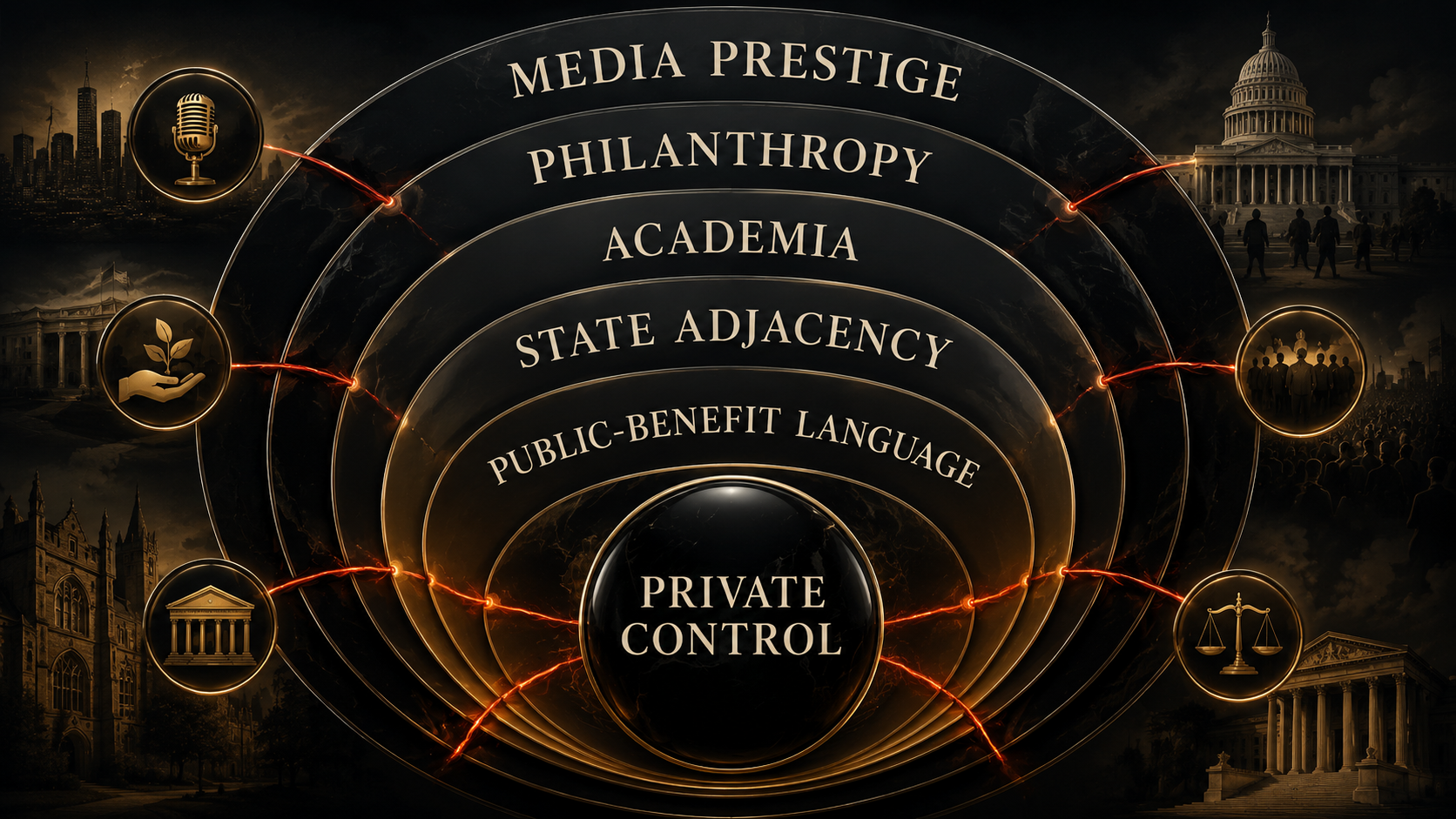
It does not erase incentive structure.
It does not erase the material effects of lobbying, capture, procurement, prestige, or selective disclosure.
It only softens them.
Sometimes that softening extends into explicitly moral domains. Religion, philosophy, existential risk discourse, humanitarian framing, and civilizational ethics all become part of the permission environment. Again, the claim here is not that every moral actor is compromised in a simple way. The claim is that moral blessing, elite prestige, and institutional access function as power stabilizers whether or not everyone involved thinks of themselves that way.
The legitimacy machine matters because it helps concentration survive the phase when concentration should still feel politically unstable.
It tells the public:
Don’t worry, the powerful are thoughtful.
Don’t worry, the enclosure is responsible.
Don’t worry, the state intimacy is safety-minded.
Don’t worry, the private gatekeepers are future-conscious.
Don’t worry, this is all being handled by the right adults.
That is one of the oldest imperial songs in history.
This time it is being sung through model demos, ethical language, and highly networked institutional approval.

For younger readers this part can feel especially slippery because the vibe is so polished. Nothing looks like a villain speech. It looks like smart people in good clothes saying careful things about humanity. That is exactly why it works. Extraction in a hoodie was easier to distrust. Extraction in ceremonial language takes longer to name.
The point is not to reject every institution that touches the field. It is to stop confusing institutional contact with democratic legitimacy. A company can be invited, praised, platformed, sermonized about, researched, and ceremonially elevated without becoming accountable in the way real public infrastructure must be accountable. If anything, those gestures can make accountability harder by giving the public a fog of respectability to look through before it reaches the underlying ownership structure.
For a younger audience, this can be the hardest power move to see because it arrives as vibe before doctrine. It looks like the smartest people in the room speaking softly about humanity, risk, responsibility, and the future. It looks tasteful. It looks nuanced. It looks above the mess. But polished language can still do dirty political work. The more sacred the tone becomes, the less ordinary people feel permitted to ask ordinary democratic questions about ownership, access, subsidy, procurement, lobbying, or who exactly gets to govern a machine built from everyone’s world.
That is why legitimacy belongs in the anti-capture story, not next to it as a softer side topic. Capture is easier when admiration has already done half the work. The public pushes less. The press frames more gently. Policymakers grant more deference. Universities absorb the prestige. Philanthropy launders ambition through moral language. The machine stops looking like a private concentration problem and starts looking like the responsible center of the future.
That is exactly the mood this chapter is trying to break.
This chapter adapts the documentary argument developed in the research paper Chapter 08: Power Network, Legitimacy, and Institutional Capture. The PDF version is here. That paper follows the structural record on governance, lobbying, prestige, policy access, state adjacency, and bounded treatment of sensitive named-individual material.
Once legitimacy stabilizes concentration, the future starts narrowing quietly. The next chapter asks what kind of everyday world emerges if this arrangement is allowed to keep hardening.
What comes next if dependence, enclosure, and state-corporate fusion harden into infrastructure.

The most believable nightmare is not a robot apocalypse.
It is a flatter, quieter world.
A world where judgment weakens by convenience.
Where labor softens by attrition.
Where attention never fully comes back.
Where more and more people rely on systems they do not govern, do not meaningfully audit, and cannot realistically refuse without losing social, cultural, or economic ground.
That future does not arrive with laser eyes and a dramatic soundtrack.
It arrives through continuity.
Continuity is dangerous because it never sounds as intense as rupture, even when it changes life more deeply. A lot of people are waiting for a single dramatic moment that proves the age has tipped. But most structural losses do not look like that in real time. They look like one more workflow moving into the model layer. One more institution outsourcing judgment. One more generation learning that stillness feels unbearable. One more labor pool told to adapt downward. One more public body leaning on private intelligence infrastructure because it is easier than building sovereign alternatives.
Nobody stands at a podium and announces: today we outsource a little more memory, a little more authorship, a little more confidence, a little more focus. The transfer happens through convenience, through repetition, through the low-friction seduction of never having to sit with difficulty for very long.
That is how sovereignty thins.
Not with one speech.
With repetition.
If no one acts, the social order described in the earlier chapters does not need to become science fiction to become intolerable. It only needs to keep consolidating. Young people remain raised inside recommendation systems that know how to monetize restlessness. The archive remains privately enclosed into model capability. The technical middle class remains easier to discipline because automation theater weakens leverage. Governments remain increasingly entangled with the same firms they are supposed to regulate. The public remains cognitively tired enough to confuse access with power and convenience with legitimacy.
In that world, inequality becomes more than economic.
It becomes cognitive.
Some actors will buy privileged proximity to the frontier.
Some states will negotiate sovereign access.
Some companies will sit inside the stack where rules are made.
Some universities and institutions will orbit the prestige field.
Some elites will also buy fallback itself: backup land, hardened compounds, offshore legal options, redundant energy, private security, the ability to leave a breaking system while everyone else is told to keep trusting it.
And everyone else will be told that they still live in an open society because there is a consumer interface somewhere in the chain.
That is not democratization.
That is tiered intelligence wrapped in mass-market UX, with tiered survivability waiting behind it.
The danger is especially sharp for the generations already shaped by the feed. A reader who spent adolescence inside algorithmic ranking may spend adulthood inside model-mediated cognition. First the system fragments attention. Then it offers synthetic assistance for the very forms of concentration it helped erode. First it industrializes comparison. Then it offers soothing machine counsel. First it captures the archive. Then it licenses pieces of thought back as premium functionality.
That loop is not futuristic.
It is already here in embryo.
What changes in the continuity scenario is scale and normalization.
The user stops noticing how much internal life has been externalized because externalization becomes ordinary. Memory goes out. Drafting goes out. Search judgment goes out. Interpretation goes out. Taste sometimes goes out. Administrative reasoning goes out. Small acts of thought become increasingly scaffolded by systems whose ownership and obligations remain private and strategic.


Some assistance is genuinely helpful.
That is not the issue.
The issue is what happens when helpfulness scales without democratic control.
What happens when whole populations become dependent on machine-mediated cognition while the governance of that cognition remains concentrated.
What happens when the tools that mediate thought are also bound up with state access, labor discipline, and surveillance-era business models.
That is the continuity risk.
Not Skynet.
A slower civic downgrading.
A cultural atmosphere of permanent managed dependence.
A society that becomes less practiced at judgment while being told it has never had more intelligence at its fingertips.
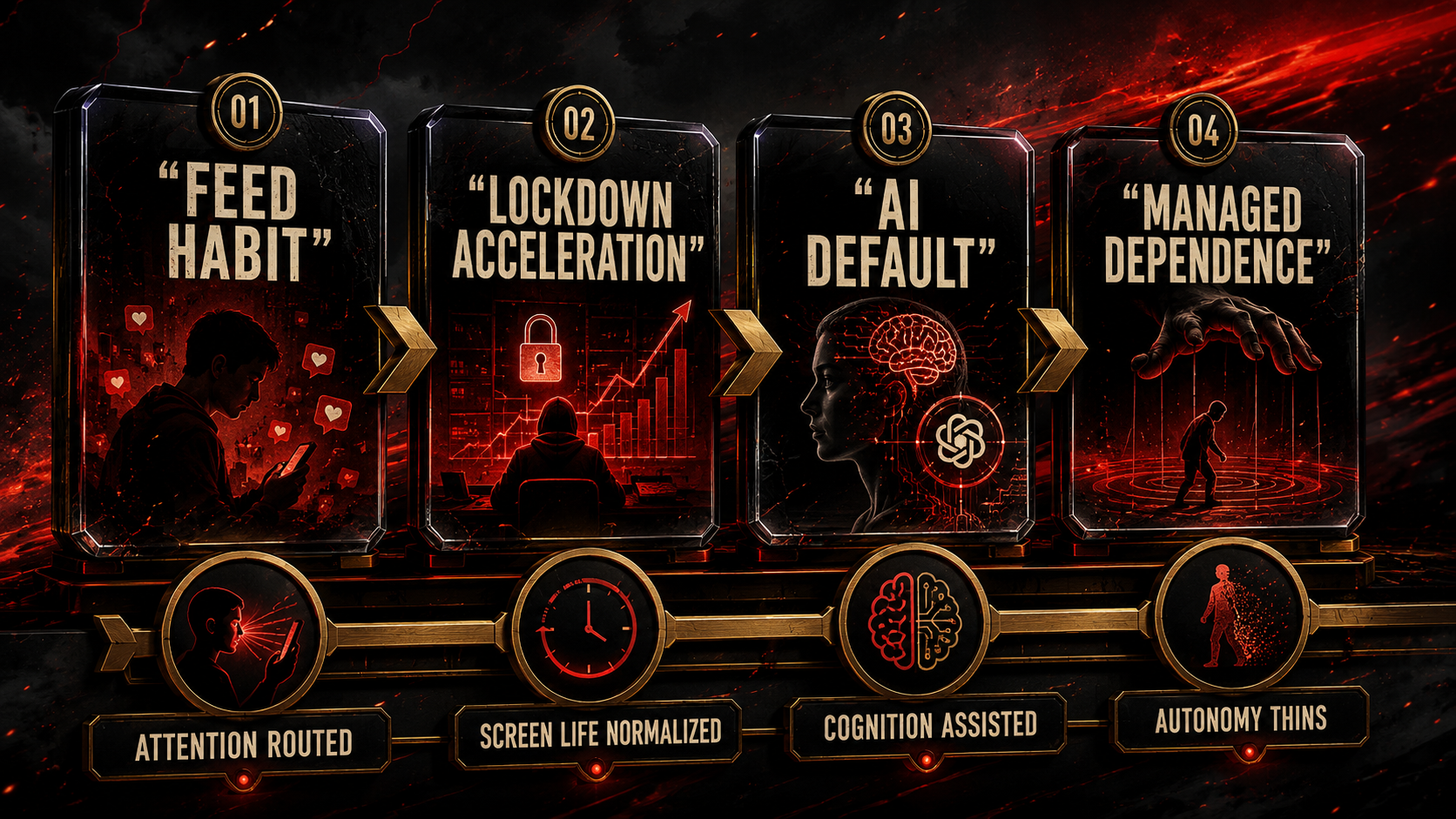
This future also reshapes ambition in subtle ways. If the model becomes the default drafting partner, research assistant, planning engine, and interface to knowledge, then the human relationship to difficulty may change too. Some friction disappears in good ways. Some friction disappears in ways that flatten patience, intellectual ownership, and the slow confidence that comes from wrestling something into clarity yourself. A generation already trained by the feed to expect immediate stimulation may be further trained by the model to expect immediate cognitive support.
That is not universal doom.
But it is a civilizational tradeoff.
And one of the cruelest parts of the continuity scenario is that it can feel subjectively comfortable while remaining politically degrading. Many people may genuinely like parts of it. Faster writing. Easier coding. Less blank-page pain. More responsive search. More ambient guidance. That is what makes the structure hard to confront. Domination that also delivers convenience can become sticky fast.
Older political vocabularies still struggle with that. People are used to imagining domination as obviously violent, visibly hated, impossible to mistake for help. But digital dependence often arrives padded, personalized, almost caring in tone. It says: let me help. Let me draft that. Let me remember. Let me suggest the better phrasing. Let me make the hard part less lonely. And because modern life already exhausts people, that kind of domination can feel merciful before its costs are fully legible.
If no one acts, the public language around freedom may shrink without admitting it. Freedom will increasingly mean choosing among interfaces inside a hierarchy you do not govern. Creativity will increasingly mean working alongside systems trained on collective culture but owned through narrow channels. Work will increasingly mean competing beside machines invoked as both helpers and threats. Public reasoning will increasingly occur in environments mediated by the same model infrastructures whose politics remain opaque to most users.
The nightmare is not dramatic enough for movies.
It is real enough for policy.
It is intimate enough for daily life.
And it is already legible enough that neutrality starts looking like surrender.
There is also a risk that the social imagination itself narrows. Once enough people internalize the idea that intelligence is now something primarily accessed through private model layers, they may stop expecting public alternatives altogether. That is how enclosure wins twice. First materially, by controlling the infrastructure. Then psychologically, by shrinking what the public can even picture as realistic. The future starts sounding like a menu of proprietary options rather than a governance question.
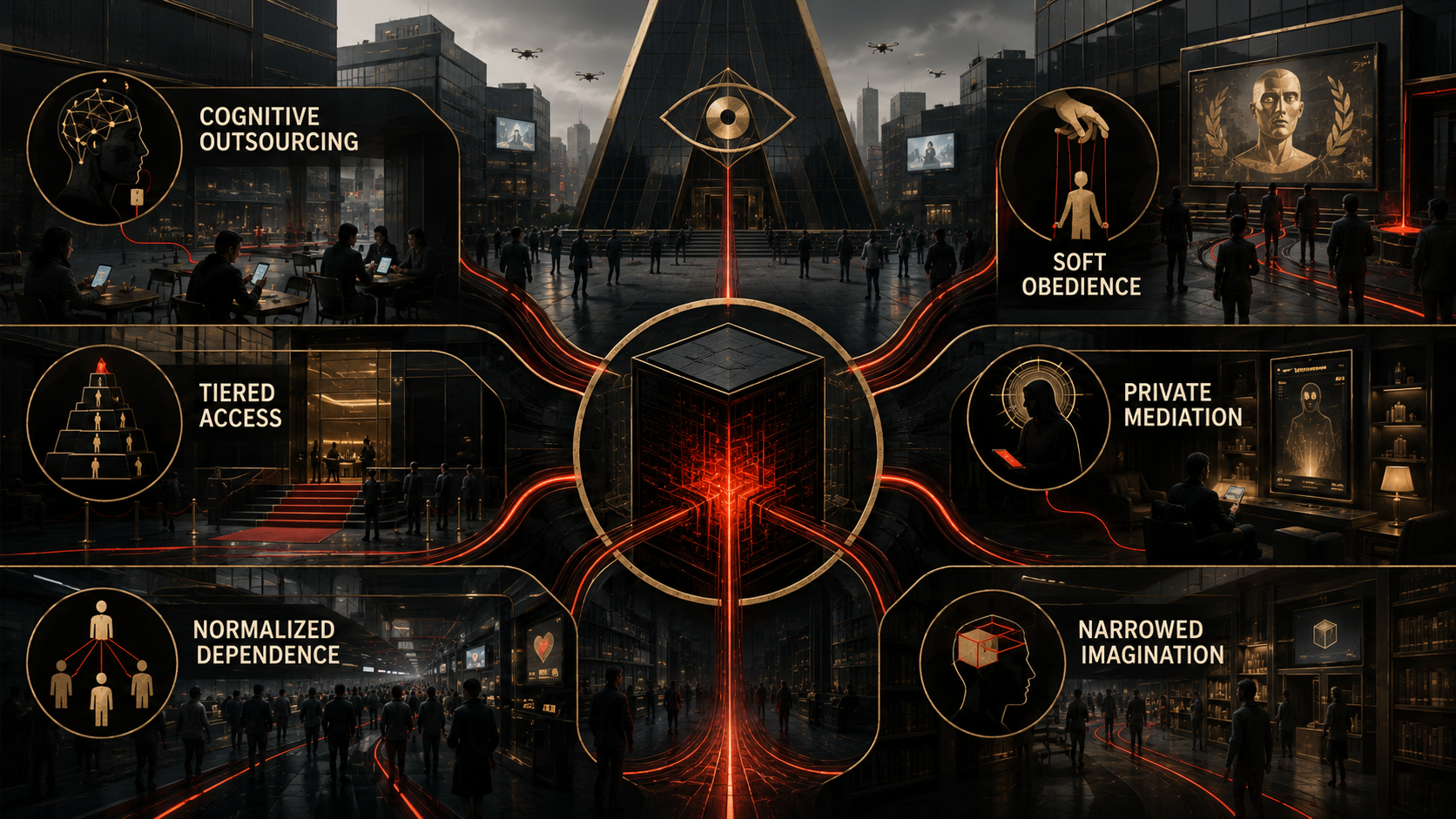

That narrowing is especially dangerous for young readers because it can become identity-level realism. If you were raised inside ranked feeds and enter adulthood inside ranked intelligence systems, private mediation can begin to feel like the natural shape of reality. Not an arrangement. Not a political choice. Just how the world works. Once a generation starts feeling that way, reform becomes harder because resignation masquerades as maturity.
That is why this whole project is also a fight over imagination. The system does not only want labor and data. It wants your baseline sense of what counts as normal, possible, realistic, worth fighting for. If it can get you to say “yeah, this is just the world now,” then half the governance battle is already over before the law even catches up.
That is why this chapter insists on continuity as the enemy. Continuity is what makes domination look normal. Continuity is what lets social exhaustion pass for adaptation. Continuity is what keeps people saying “this is just where things are going” instead of asking who exactly is doing the steering and why everyone else is being asked to call that inevitability.
This chapter adapts the documentary argument developed in the research paper Chapter 09: Future if No Action Is Taken. The PDF version is here. That paper turns the upstream record into a bounded continuity scenario rather than a sensational apocalypse narrative.
If the continuity scenario is the danger, the answer cannot remain mood, critique, or doomscrolling with better vocabulary. The final chapter states the three reforms directly.
The response is no longer a mood. It is a program.

This book does not end with a self-care checklist and a request for nicer billionaires.
It does not end with “maybe unplug more.”
It does not end with “hopefully the market figures it out.”
And it definitely does not end with the exhausted fantasy that if users just become a little more disciplined, the architecture itself will somehow stop being extractive.
No.
The problem is structural.
So the answer has to become structural too.
If the feed became territory, if the archive became private capability, and if access to advanced intelligence is being consolidated through state-adjacent corporate power, then a serious response has to move at the level of law, ownership, and public obligation.
That is why this book closes with three reforms, not thirty vibes.
There is a reason the ending has to sound firmer than the opening. By this point the reader has already walked through the harvest, the social damage, the acceleration, the enclosure, the layoffs, the access hierarchy, and the legitimacy theater. If the book ended with “it’s complicated,” that would not be nuance. That would be surrender in expensive prose.
The first reform is to refactor Section 230 around reality rather than nostalgia.
The old legal imagination behind platform immunity was built for an era when the internet could still be pictured as a host environment rather than a behavioral command architecture. That imagination is obsolete. It does not describe what sovereign-scale platforms actually do.
These systems do not merely store speech. They rank it, amplify it, suppress it, route it, recommend it, monetize it, target it, and build predictive systems out of its aftermath. They shape what rises, what disappears, what becomes desirable, what becomes punishing, what is rewarded, and what is rendered socially invisible.
That is not neutral carriage.
That is governance by design.
If a system can tune visibility for billions, it is not a passive intermediary in any meaningful moral sense. It is infrastructure with editorial, psychological, and civic consequences at scale. A platform this powerful can no longer receive the same liability logic as if it were a dumb wall covered in stranger graffiti.
What should replace that fiction? Responsibility keyed to reach, amplification power, monetization structure, targeting architecture, moderation design, and systemic harm. Not perfection. Not impossible prior review of all human speech. But real duties proportional to power.
This is especially important for the generations this book is written to. Gen Z and millennials did not mainly encounter these systems as abstract policy entities. They encountered them as developmental environments. Systems that shaped beauty, status, sexual signaling, moral outrage, belonging, loneliness, and attention collapse. The law cannot keep acting as if all of that was random user behavior floating on top of neutral plumbing.
We are past that stage.
The platform is not just where harm happens.
The platform is often part of how harm is formatted, intensified, and monetized.
What this means in ordinary language is simple: if a company designs the weather, it cannot keep pretending it merely hosts the rain. Once a system ranks desire, outrage, beauty, panic, belonging, and humiliation at population scale, it becomes part of the causal machinery of the social world. That does not require impossible liability for every utterance. It requires ending the childish fiction that sovereign-scale behavioral infrastructures are just neutral bulletin boards with better branding.

The second reform is to treat frontier AI weights trained on humanity’s collective expression as a patrimony question, not merely a private-property question.
This is the intellectual heart of the whole project.
If the systems now being sold as frontier intelligence are built from human civilization in compressed form, then it is morally and politically absurd to treat them as if they were ordinary assets generated in a vacuum by whoever reached the compute cluster first. Not because current law has already settled the matter. It has not. But because the social reality already outruns the inherited categories.
A frontier weight is not a human mind.
It is not a literal copy of civilization.
It is not a soul in a server rack.
But it is also not detached from the public archive that made it possible.
That archive includes language, culture, art, code, expertise, memory, style, pedagogy, and labor created across societies, classes, and generations under wildly unequal conditions of consent and compensation. Once that collectively generated world becomes private machine power, the burden should shift. Firms should have to justify enclosure, not the public justify why it deserves a stake in what was built from its residue.
That is what patrimony means here. A framework in which frontier capability triggers public-trust reasoning, anti-monopoly limits, democratic oversight, transparency obligations, and a presumption against total private enclosure of intelligence built from collective life.
The end state argued for in this book is not naive chaos.
It is not “release everything and hope for the best.”
It is not pretending there are zero safety concerns.
It is something more demanding: move the center of gravity away from permanent private scarcity and toward broad public-interest availability, utility-like obligations, and governance structures that acknowledge the collective origin of the capability.
Put differently:
If humanity helped build the field, humanity should not be treated as a mere customer standing outside the fence.
And that is where this project parts ways with the timid version of reform. Too much public debate still treats the weights fight like a niche copyright argument for specialists. It is bigger than that. It is a civilizational ownership argument. Either intelligence built from collective human residue remains permanently enclosed by whoever captured the best legal and compute position first, or we admit that a capability generated from humanity at scale carries public-trust implications by default.
The third reform is to limit government capture by AI companies and, just as importantly, limit corporate capture of public intelligence infrastructure.
This one matters because private concentration gets even more dangerous once it fuses with public power under low-visibility conditions. If a small number of frontier firms sit inside procurement channels, defense pathways, national-security coordination, public funding streams, export-control privilege, or strategic state access, then their obligations should increase dramatically.
No more soft-focus language about partnership as if partnership itself were automatically virtuous.
No more pretending that public dependence on private intelligence vendors is just another procurement detail.
No more shrugging at revolving doors, lobbying intensity, opaque model-risk practices, or selective disclosure because everyone is too mesmerized by the product layer.
If public institutions are going to rely on frontier AI systems, then the public gets a right to more than glossy marketing and elite reassurance.
At minimum, that means:
This is not anti-state coordination. States will obviously interact with major AI systems. The point is not to ban contact. The point is to stop treating opaque entanglement as normal. A firm that receives public support, public privilege, or national-security intimacy while controlling a layer of future intelligence infrastructure should be judged less like a charismatic startup and more like a public-risk actor with heightened obligations.
That is the anti-capture doctrine in plain language:
the closer a private firm gets to public intelligence infrastructure, the less acceptable secrecy, unilateral enclosure, and unaccountable privilege become.
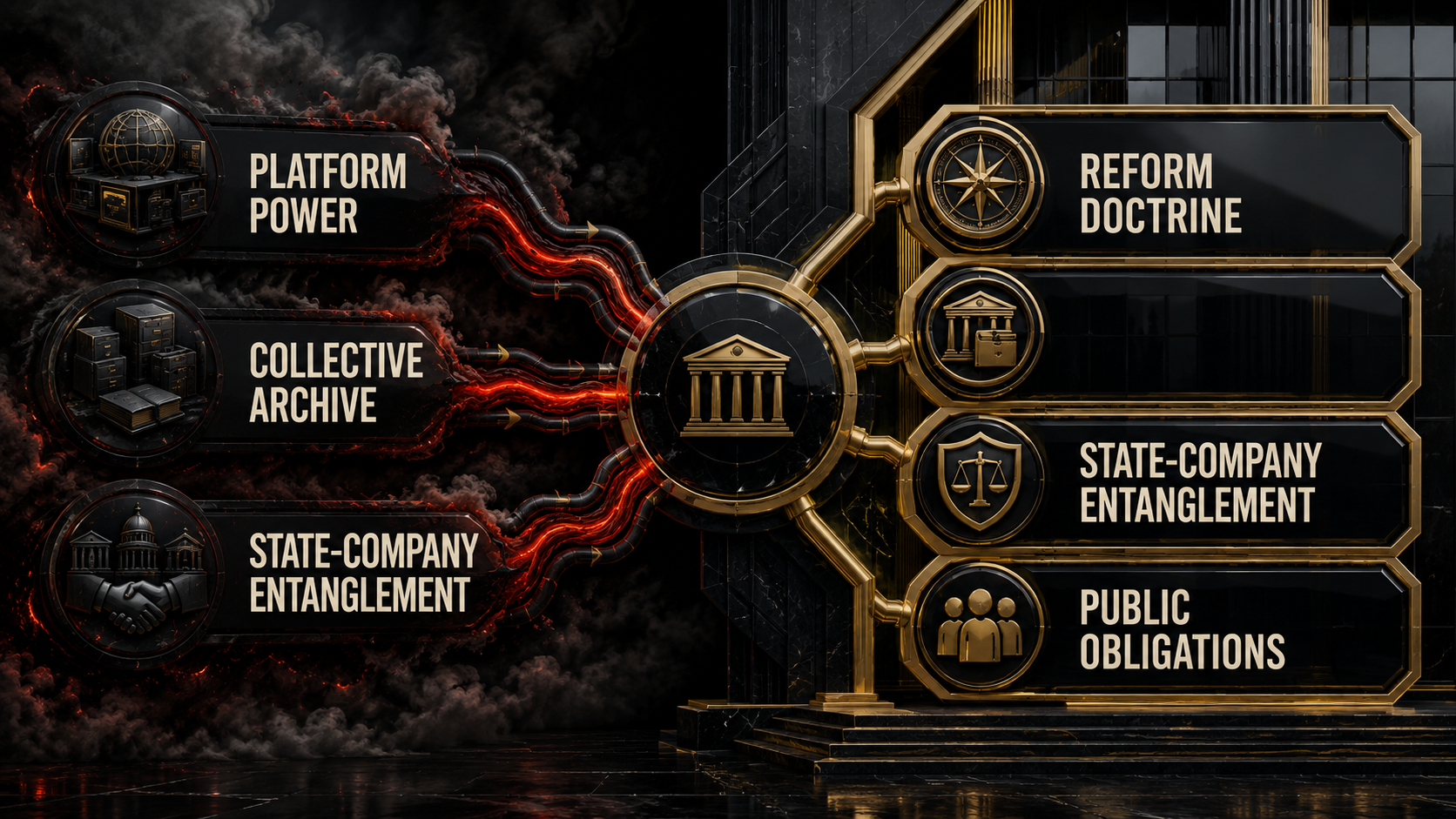


Everything else readers may want to do still matters. Digital hygiene matters. Cognitive recovery matters. Labor organization matters. Competition policy matters. Open public infrastructure matters. Youth education matters. Cultural criticism matters. Refusing total dependence matters.
But those are not alternatives to the three reforms.
They are what make the reforms livable.
They are implementation arms, not substitutes.
That distinction is important because a lot of public conversation gets trapped at the lifestyle layer. Should we use the tools less? Should parents monitor more? Should workers reskill? Should artists adapt? Sure, some of that has a place. But if the architecture of extraction, enclosure, and capture remains intact, lifestyle adaptation becomes unpaid maintenance of a system that keeps deepening the harm.
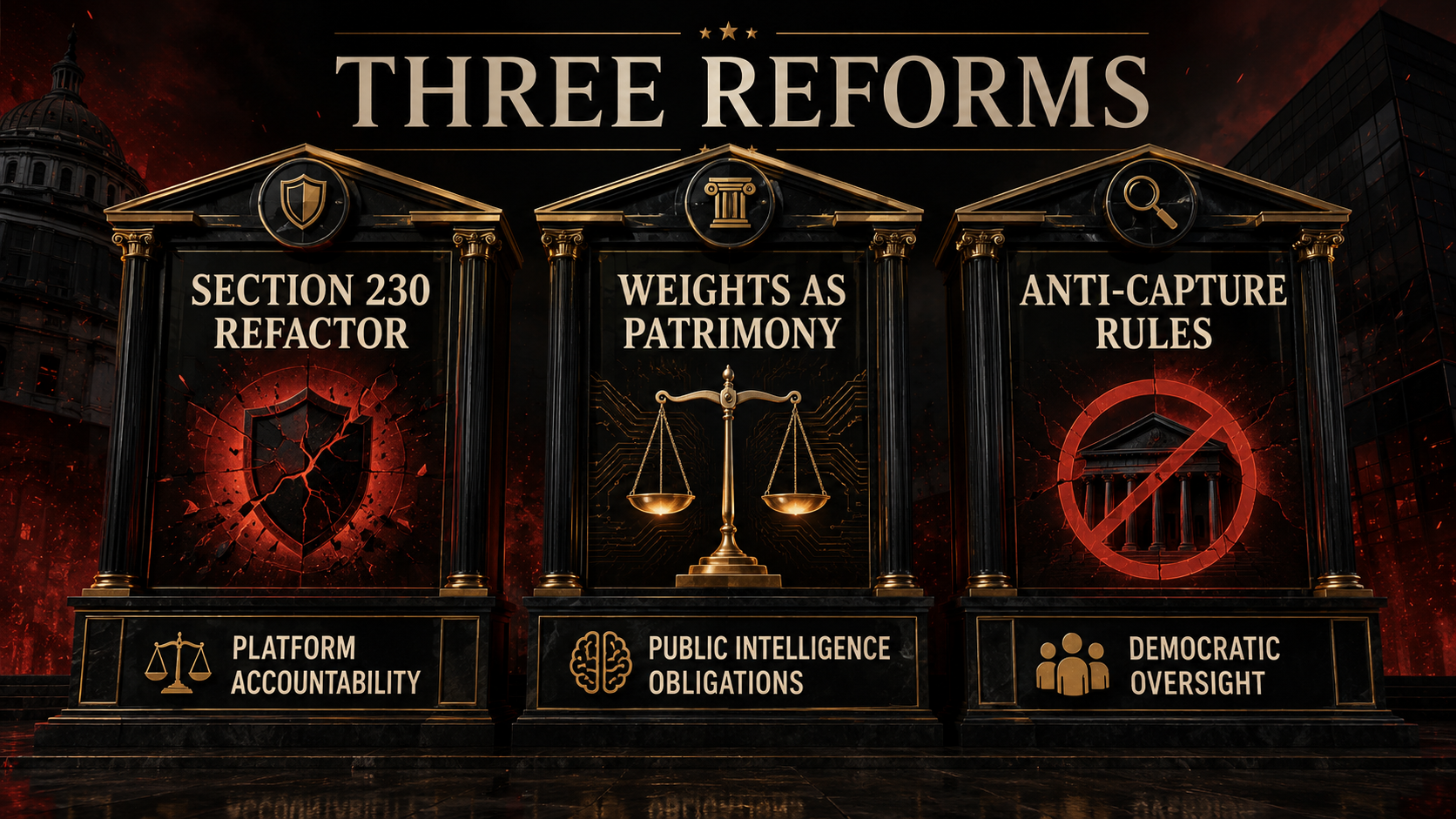
The point of ending with reforms is not to pretend politics is easy.
It is to refuse the fake maturity that says diagnosis without doctrine is enough.
It isn’t.
A generation needs more than critique.
It needs naming.
Then structure.
Then terms of refusal.
Then terms of reconstruction.
That is the real emotional promise this book is trying to keep with the reader. You are not crazy for feeling that something broke. You are not weak because the feed rewired you. You are not obsolete because a model can imitate pieces of your labor. You are not overreacting because the state-company relationship around frontier AI feels off. You are living inside a system that industrialized dependency and is now trying to rename the result as destiny.
Destiny is the word power uses when it wants obedience without debate.
This book rejects that word.
The future is not something these firms get to inherit by default because they were first to turn our residue into machine power.
The future is still a governance fight.
And if we are serious, it starts here:
Refactor Section 230.
Treat AI weights as a patrimony of humanity question.
Limit government capture by AI companies.
Everything else depends on whether those three moves become thinkable at scale.
This chapter adapts the documentary argument developed in the research paper Chapter 10: What To Do. The PDF version is here. That paper states the three-reform program directly and grounds it in the documented upstream record on platform design, training conflict, access control, and institutional capture.
The literary book ends here, but the work it argues for begins outside the page: in law, in labor, in public language, in technical governance, and in the refusal to keep calling extraction inevitable just because it learned how to speak back.
This literary edition is a public-facing adaptation of the AI Empire research program. It simplifies the scholarly apparatus without weakening the distinction between documented fact, disputed fact, and bounded interpretation. Readers who want the full documentary burden should move from each chapter’s research-basis note into the corresponding standalone paper and then into the omnibus and corpus companion.
The literary edition uses a magazine-style visual language and a mixed asset system: dramatic chapter-cover art, richer infographic charts, a provided master cover, and selected GPT Image 2 narrative illustrations.
To our beloved:
Copyright Hassan Uriostegui 2026