The empire does not survive by code alone. It survives by praise, access, prestige, and institutional blessing.

Power wants to be admired before it is resisted.
It wants the glowing profile before the hearing.
It wants the summit stage before the subpoena.
It wants the policy dinner, the university panel, the prestige podcast, the careful magazine spread, the vocabulary of concern that teaches everyone else which power is supposed to feel too sophisticated to doubt.
That is why frontier AI firms do not only build models.
They build boards.
They build policy lanes.
They build safety language.
They build philanthropic halos.
They build relationships with governments, universities, think tanks, defense structures, media institutions, and the kinds of symbolic authorities that teach the public which concentrations of power are dangerous and which are visionary.
The machine is not enough by itself.
The machine also needs a story.
This is the layer where concentration learns how to smile.
The extraction story is still there.
The enclosure story is still there.
The labor-disciplining story is still there.
The access hierarchy is still there.
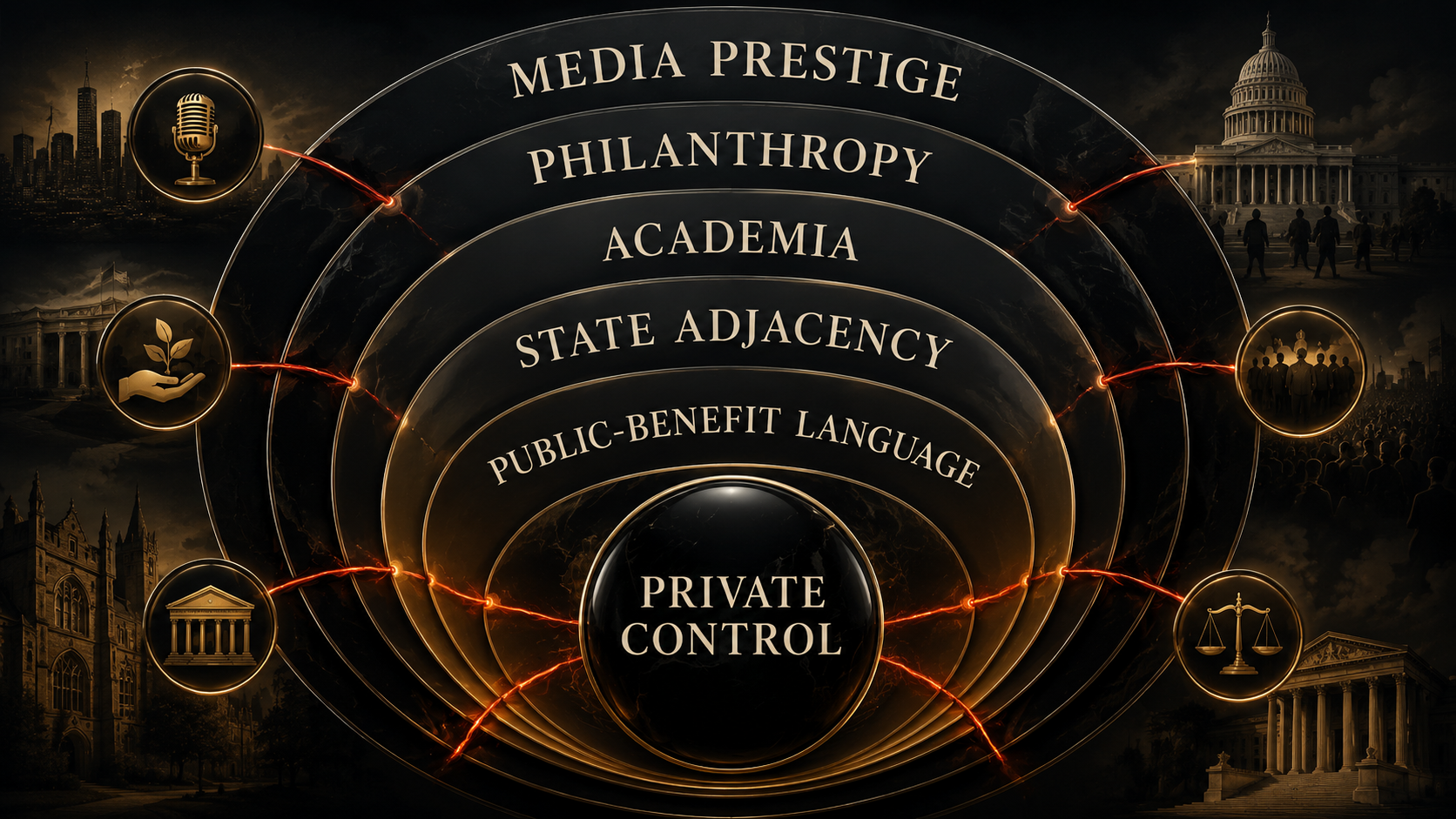
But on the surface, the tone changes. The firms begin speaking in the language of stewardship, humanity, safety, alignment, democratic concern, public benefit, and civilizational responsibility. Some of that concern may be real at the level of individual belief. But structurally, it also does something else: it stabilizes contradiction long enough for power to harden.
That is what legitimacy is doing here.
It lets firms say they fear concentrated power while continuing to accumulate it.
It lets state intimacy appear as responsibility rather than capture.
It lets elite praise flatten popular suspicion.
It lets extraordinary private control wear the costume of reluctant guardianship.
And because the products themselves really are impressive enough to create awe, the narrative machine does not have to work from nothing. It only has to attach prestige to concentration before the public fully absorbs what concentration means at this scale.
This chapter has to keep its discipline, especially around people and scandal. There is always a temptation, in work like this, to turn orbiting personalities into the story itself. To collapse structure into gossip. To imply guilt through adjacency because adjacency makes the writing feel hotter. The dossier rule is the opposite: no guilt by association, no lurid substitution for real institutional analysis, no naming that outruns relevance.
That is not restraint because the subject is soft.
It is restraint because the structural case is stronger.
The stronger case says this: when a small number of frontier firms can move through lobbying channels, public-benefit language, state partnerships, defense adjacency, philanthropic legitimacy, future-of-humanity rhetoric, and even moral or religious prestige fields, they cease to look like ordinary market actors. They start to look like aspiring custodians of public intelligence infrastructure without corresponding public accountability.
That is what makes the legitimacy field dangerous.
Not that it is fake in a cartoonish sense.
But that it blends real concern, genuine talent, elite access, and institutional self-interest into a permission structure that is easy for the broader public to misread.
The permission structure matters because most people do not audit power at the source level. They infer legitimacy from context. If respected newspapers interview the founders like tragic geniuses, if public institutions invite them into the room, if universities flatter them, if philanthropic narratives cast them as guardians, if policy circles treat them as indispensable adults in the room, then private concentration begins to feel less like a threat and more like a burden these firms nobly carry on behalf of everyone else.
That is respectability laundering at civilizational scale. Not because every actor involved is cynically coordinated, but because prestige compounds. One panel, one fellowship, one award, one pulpit, one carefully staged conversion story at a time, the enclosure stops looking like enclosure and starts looking like stewardship.
This is why governance theater matters so much. A public-benefit label, a safety board, a moral advisory frame, a prestigious summit appearance, a promise to donate wealth, a careful partnership announcement with state or civil institutions, even a high-minded warning about how powerful the technology is becoming: none of these things are meaningless, but none of them settle the underlying power question either. They can just as easily function as soft architecture around concentration, especially when outsiders are so dazzled by capability that they start treating symbolic restraint as equivalent to structural accountability.
And then there is the moment when the stated preference and the revealed preference stop matching. Publicly, the stewards of the new intelligence order speak in the language of responsibility, humanity, and collective future. Privately, some of the same elite circles invest in retreat property, underground shelters, backup jurisdictions, private security logic, and the material possibility of getting out. That does not prove they are plotting collapse. It does not prove a secret command center behind history. But it does reveal something ugly about the social contract they are asking everyone else to accept. If the future is good enough for the public only with private blast doors in reserve, then legitimacy starts to curdle. Call that the bunker class if you want. The point is not the bunker. The point is the exemption.


That is how myth hardens around infrastructure.
And because AI is now linked to civilizational language more than most recent technologies were, the myth can get especially grand. The machine is not just useful. It is historic. Not just profitable. Necessary. Not just powerful. Maybe humanity’s next decisive layer. Once firms are allowed to sit inside that register without robust public challenge, their private decisions start acquiring the emotional aura of quasi-public destiny.
That is a huge transfer of authority.
And it is one that many liberal institutions are oddly vulnerable to because the language of responsible stewardship sounds so much nicer than the language of empire.
That vulnerability is cultural as much as procedural. A lot of elite institutions desperately want to believe that concentration becomes acceptable when the concentrated actor sounds self-aware enough. Give power the right vocabulary and half the room relaxes. Say alignment. Say responsibility. Say existential caution. Say democratic concern. Say public benefit. Say safety. The terms are not meaningless, but they can function like liturgy when the audience wants reassurance more than redistribution of power.
That is why the religious metaphor in this project matters even when it stays metaphorical. Nobody has to literally worship the machine for institutional behavior to start looking devotional. All it takes is a class of people willing to treat proximity to capability as moral seriousness, and to confuse a refined tone with legitimate ownership.
That is why public-benefit conversion stories, board restructuring stories, or future-of-humanity language cannot be judged by rhetoric alone. They have to be read against material control. Who still owns the capability? Who still sets access rules? Who still governs model deployment? Who still benefits when the system scales? A vocabulary of care attached to a structure of enclosure does not become justice just because the press release sounds morally literate.
That is the move a lot of smart audiences still underestimate. In the platform era, power often tried to look casual. Founder in a hoodie. Disruption as personality. Move fast and pretend the damage is just a side effect of genius. In the frontier-AI era, power is learning to look solemn instead. More cathedral, less dorm room. More “guardianship of humanity,” less “bro I built a thing.” The aesthetic matured because the stakes matured. Once a company starts sounding like it is helping govern the future of knowledge, labor, and state capacity, the old startup costume is not enough. It needs robes.
But language does not erase ownership.
It does not erase incentive structure.
It does not erase the material effects of lobbying, capture, procurement, prestige, or selective disclosure.
It only softens them.
Sometimes that softening extends into explicitly moral domains. Religion, philosophy, existential risk discourse, humanitarian framing, and civilizational ethics all become part of the permission environment. Again, the claim here is not that every moral actor is compromised in a simple way. The claim is that moral blessing, elite prestige, and institutional access function as power stabilizers whether or not everyone involved thinks of themselves that way.
The legitimacy machine matters because it helps concentration survive the phase when concentration should still feel politically unstable.
It tells the public:
Don’t worry, the powerful are thoughtful.
Don’t worry, the enclosure is responsible.
Don’t worry, the state intimacy is safety-minded.
Don’t worry, the private gatekeepers are future-conscious.
Don’t worry, this is all being handled by the right adults.
That is one of the oldest imperial songs in history.
This time it is being sung through model demos, ethical language, and highly networked institutional approval.

For younger readers this part can feel especially slippery because the vibe is so polished. Nothing looks like a villain speech. It looks like smart people in good clothes saying careful things about humanity. That is exactly why it works. Extraction in a hoodie was easier to distrust. Extraction in ceremonial language takes longer to name.
The point is not to reject every institution that touches the field. It is to stop confusing institutional contact with democratic legitimacy. A company can be invited, praised, platformed, sermonized about, researched, and ceremonially elevated without becoming accountable in the way real public infrastructure must be accountable. If anything, those gestures can make accountability harder by giving the public a fog of respectability to look through before it reaches the underlying ownership structure.
For a younger audience, this can be the hardest power move to see because it arrives as vibe before doctrine. It looks like the smartest people in the room speaking softly about humanity, risk, responsibility, and the future. It looks tasteful. It looks nuanced. It looks above the mess. But polished language can still do dirty political work. The more sacred the tone becomes, the less ordinary people feel permitted to ask ordinary democratic questions about ownership, access, subsidy, procurement, lobbying, or who exactly gets to govern a machine built from everyone’s world.
That is why legitimacy belongs in the anti-capture story, not next to it as a softer side topic. Capture is easier when admiration has already done half the work. The public pushes less. The press frames more gently. Policymakers grant more deference. Universities absorb the prestige. Philanthropy launders ambition through moral language. The machine stops looking like a private concentration problem and starts looking like the responsible center of the future.
That is exactly the mood this chapter is trying to break.
This chapter adapts the documentary argument developed in the research paper Chapter 08: Power Network, Legitimacy, and Institutional Capture. The PDF version is here. That paper follows the structural record on governance, lobbying, prestige, policy access, state adjacency, and bounded treatment of sensitive named-individual material.
Once legitimacy stabilizes concentration, the future starts narrowing quietly. The next chapter asks what kind of everyday world emerges if this arrangement is allowed to keep hardening.
To our beloved:
Copyright Hassan Uriostegui 2026